

Construction worksites
The purpose of this page is to give more information on the areas of land we would need to build the proposed DLR extension, what activities these worksites would support and the impacts on local communities, businesses and stakeholders.
A number of construction worksites would be needed to build the extension. These sites must be large enough to store construction equipment and materials, carry out construction activities, and provide welfare facilities for workers.
Common construction activities across worksites
Many of the worksites would involve similar types of construction activity. Depending on the location and stage of construction, this may include:
- Site clearance and preparation
- Groundworks and earth‑moving
- Installing deep foundations (piling)
- Diverting or protecting underground utilities
- Constructing viaducts, tunnels or station structures
- Installing track, railway systems and equipment
Equipment used may include:
- Earth-moving machines – vehicles such as excavators, bulldozers and rollers would be used to dig, move and level the ground, preparing the site for the main works
- Piling machines – large machines that would be used to create the foundations for the new railway
- Cranes and concrete equipment – used to lift heavy materials and pour concrete for new structures
- Heavy Goods Vehicles (HGVs) and other vehicles – used to take soil away from the site and deliver construction materials and concrete
- Special lifting equipment to place large viaduct sections, up to about 12 metres above ground
- Specialist tunnelling equipment – including a tunnel‑boring machine (TBM) and supporting plant needed to undertake tunnelling activities.
Beckton Riverside
At Beckton Riverside, we have identified land that would be needed to build the proposed extension. This consists of a corridor of land that follows the proposed route.
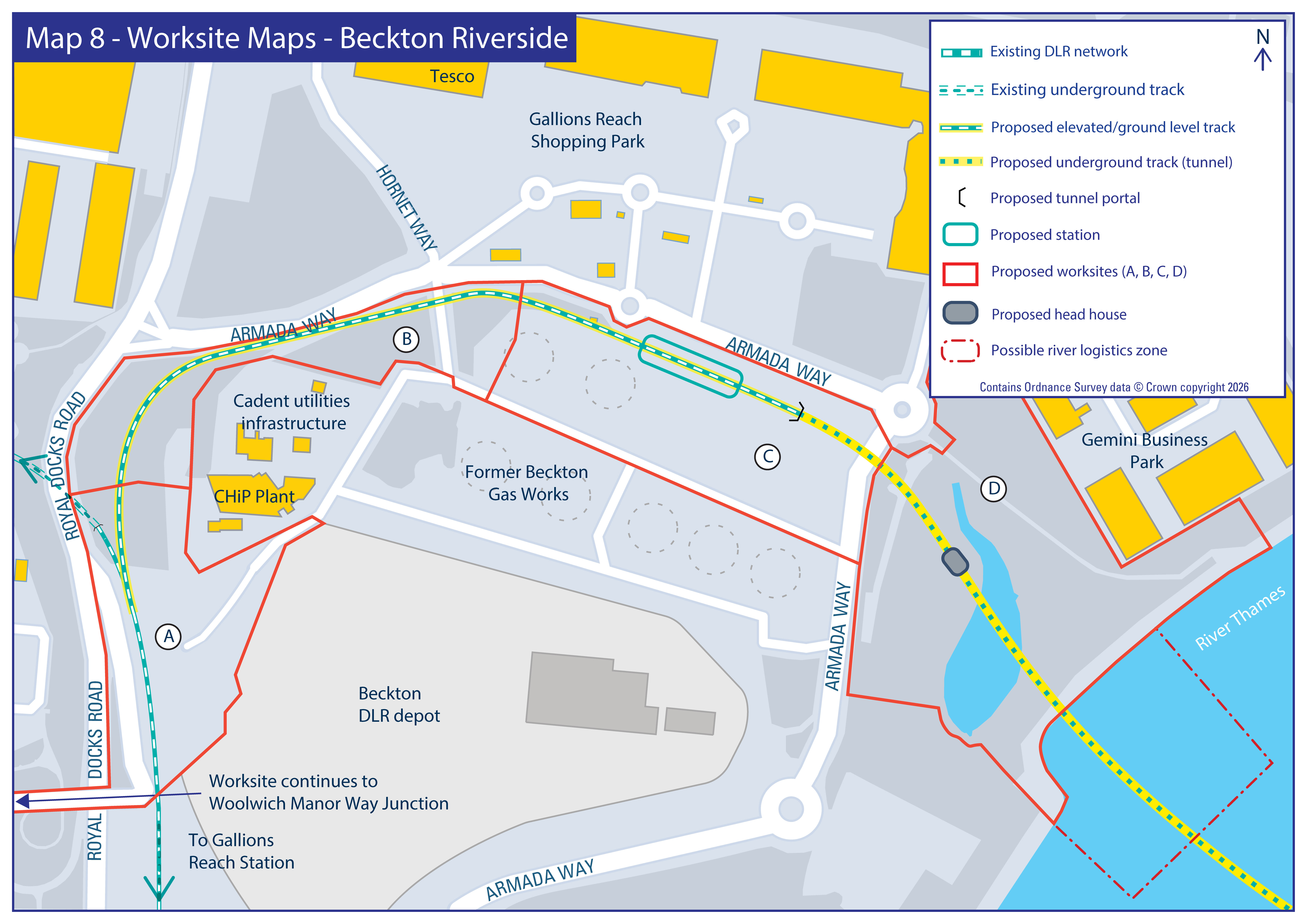
This corridor has been divided into four indicative worksites, known as Worksites A, B, C and D.
Worksite A
This worksite would use land bordered by A1020 Royal Docks Road, the Beckton Combined Heat and Power plant, and the Beckton DLR depot. Part of the site is crossed by the existing DLR line towards Beckton.
Please see the proposed worksite boundary below:
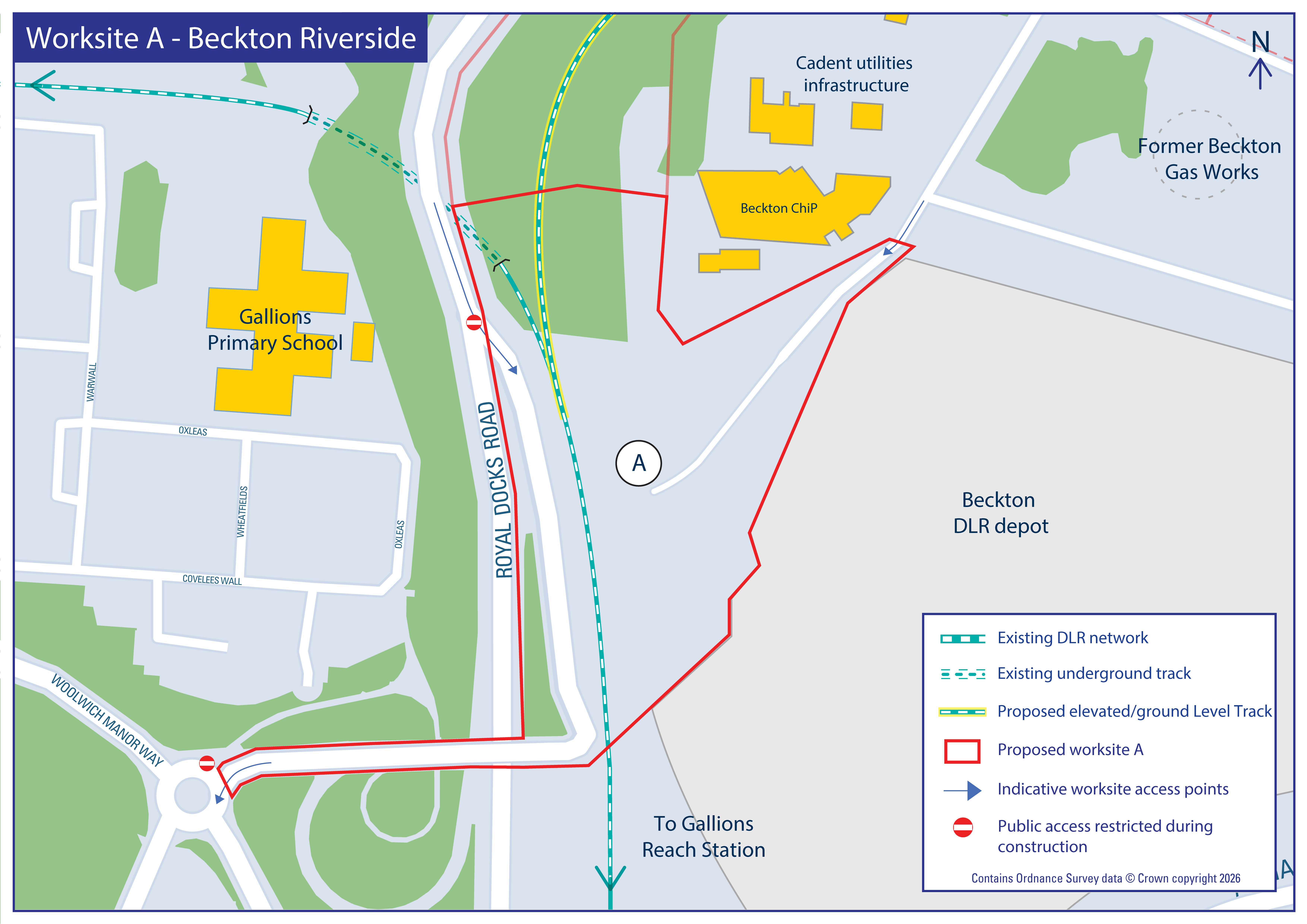
This worksite would be used to build a new link between the existing DLR line and the proposed extension.
This would involve:
- Digging and preparing the ground
- Installing deep foundations
- Building a ramp to connect to the new viaduct
- Laying new track and installing railway equipment
The worksite would include part of the Royal Docks Road southbound slip road that connects to the Woolwich Manor Way and Ferndale Street roundabout. This slip road forms part of the public highway. To ensure the work can be carried out safely, it may need to be partially or fully closed on a temporary basis. If closures are needed, a diversion would be provided via Royal Docks Road and Woolwich Manor Way to maintain access to the Woolwich Manor Way and Ferndale Street roundabout. During any closures, existing parking on the slip road would not be available.
Construction access points would be provided from Hornet Way and the Royal Docks Road southbound slip road. Vehicles accessing the site via the southbound slip road would exit via the Woolwich Manor Way and Ferndale Street roundabout. We are also exploring the potential need for an additional construction access point from Royal Docks Road, located south of the slip road, to access the southern part of the worksite.
At this time, we expect to need this construction worksite for around two years, during the middle to later stages of the construction programme.
Worksite B
This site would start at the junction of Royal Docks Road and Armada Way. It would then run along Armada Way, ending just beyond Hornet Way. It would include the land immediately south of Armada Way and the land between Royal Docks Road, the Beckton Combined Heat and Power Plant, and Armada Way. Construction access would be provided via Hornet Way; utilities suppliers in the area would also be using this road to access their existing sites.
Please see the proposed worksite boundary below:
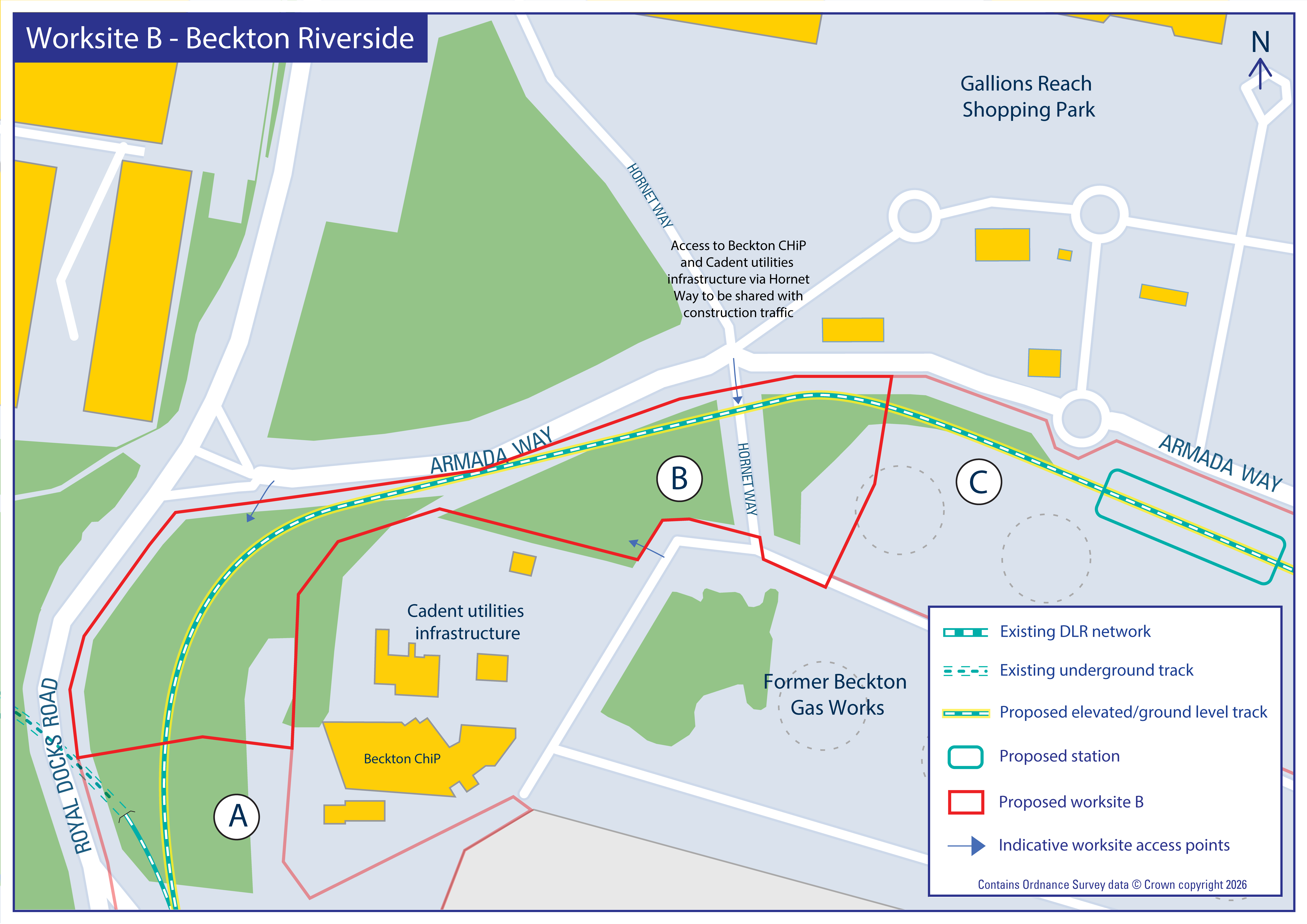
This worksite would be used to build the elevated viaduct that would carry the DLR extension from Gallions Reach towards the proposed Beckton Riverside station.
The work would include:
- Clearing the site
- Moving major utilities, including gas pipes, water pipes, sewers, and telecoms cables
- Installing deep foundations
- Installing large, prefabricated sections of the viaduct and ramps
- Laying new railway track and installing railway systems
To make space for the viaduct and utilities works, Armada Way may need to be realigned between Royal Docks Road and Hornet Way. This would involve temporary lane closures and traffic management measures such as cones and temporary signals. Full road closures are not expected but very short closures may occasionally be needed to allow the delivery of unusually large items, such as the TBM.
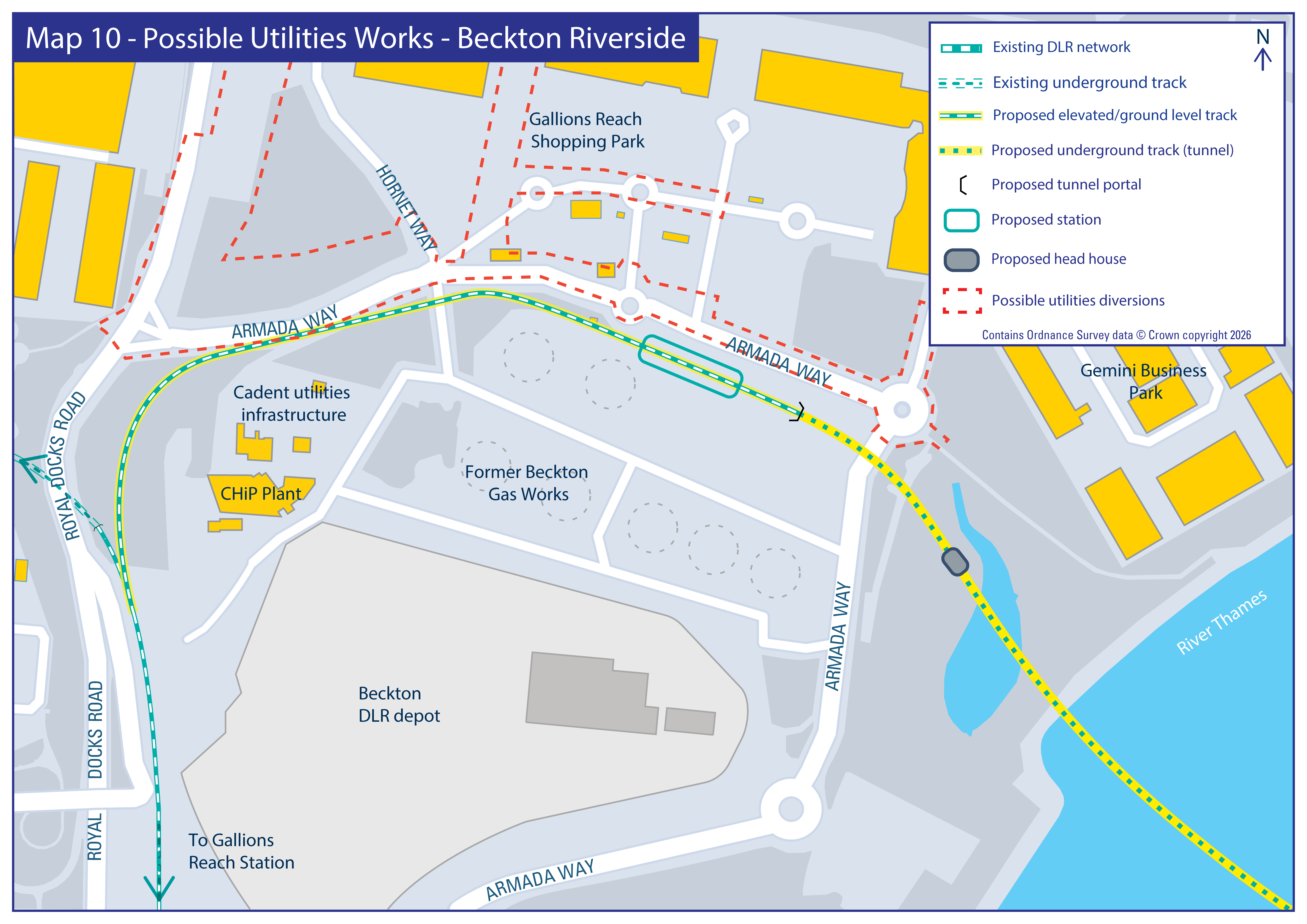
Additionally, we are assessing the impact of diverting major utilities in this area. This includes whether there would be additional worksites needed, for example impacting the car park at Gallions Reach Shopping Park, or if this can be avoided. We are working with utility providers and landowners to assess this impact and the map below shows possible diversion routes.
At this time, we expect to need Worksite B for up to three and a half years.
Worksite C
This worksite would be on the south side of Armada Way, opposite Gallions Reach Shopping Park. It would extend south-east towards the roundabout where Armada Way meets Hornet Way.
Please see the proposed worksite boundary below:
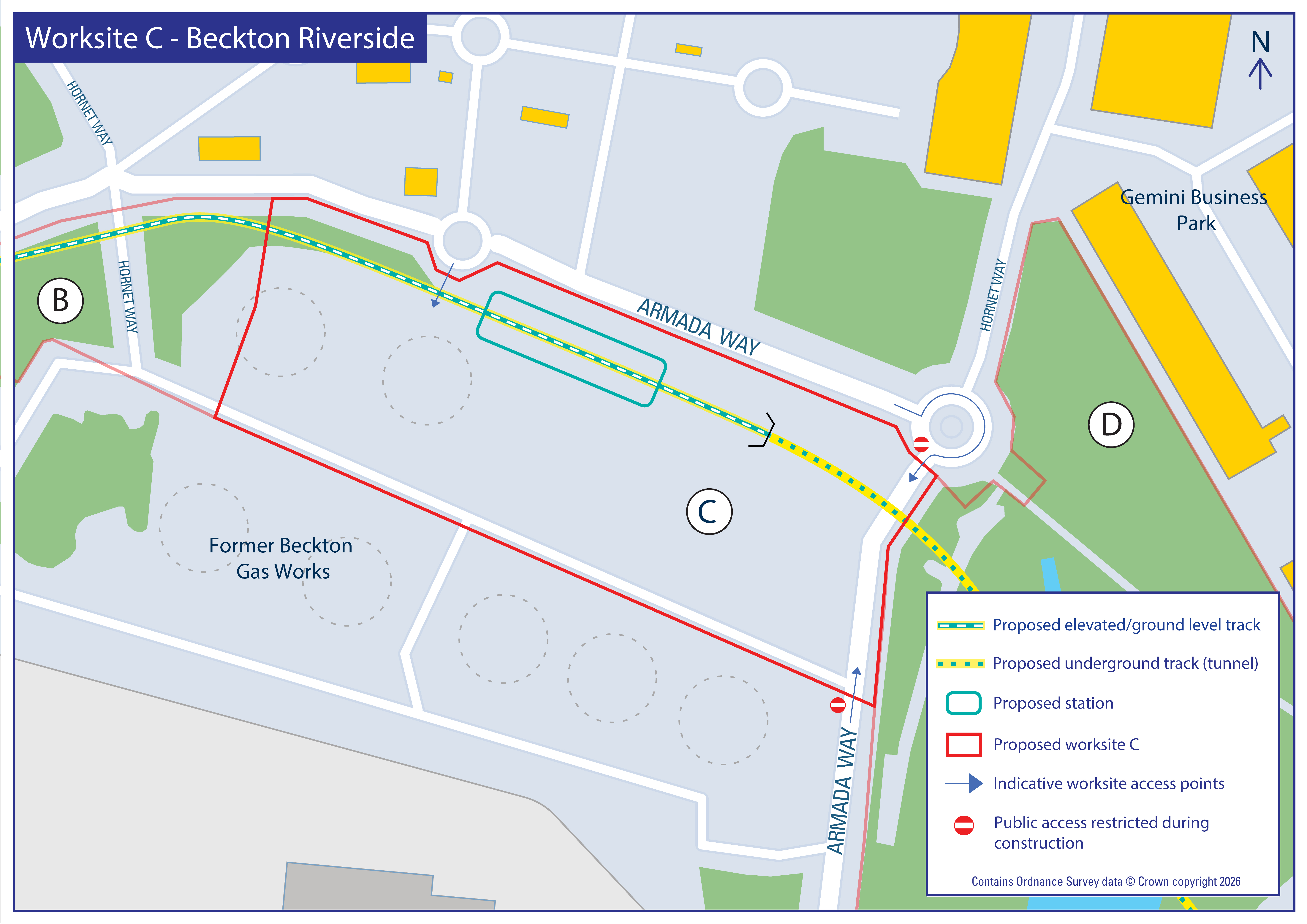
The site would be used to build the section of railway that comes down from an elevated viaduct to ground level and includes the proposed station at Beckton Riverside.
The work would include:
- Moving major utilities, including gas pipes, water pipes, sewers, and telecoms cables
- Building sections of new viaduct and the station at Beckton Riverside
- Creating a retained cutting (a section of railway below ground level, supported by walls)
- Building a shallow (cut-and-cover) tunnel to take the railway into a deeper (bored) tunnel under the River Thames
Space would also be set aside to store and handle excavated soil and materials within this worksite.
To carry out the work in Worksite C, a section of Armada Way to the south of the Hornet Way roundabout would need to be closed to allow construction of the shallow cut-and-cover tunnel. Access to Gallions Reach Shopping Park, Gemini Business Park, and the Beckton DLR depot would be maintained. We would work with local landowners and partners to keep bus services and local traffic moving during construction by exploring diversion options for the section of Armada Way impacted by Worksite C.
At this time, we expect to need this worksite for the majority of the construction programme as it would support some of the most intense activities to build the new extension.
Worksite D
This worksite would be located east of Armada Way, between Gemini Business Park and the River Thames. It would be accessed from the roundabout linking Armada Way and Hornet Way.
Please see the proposed worksite boundary below:
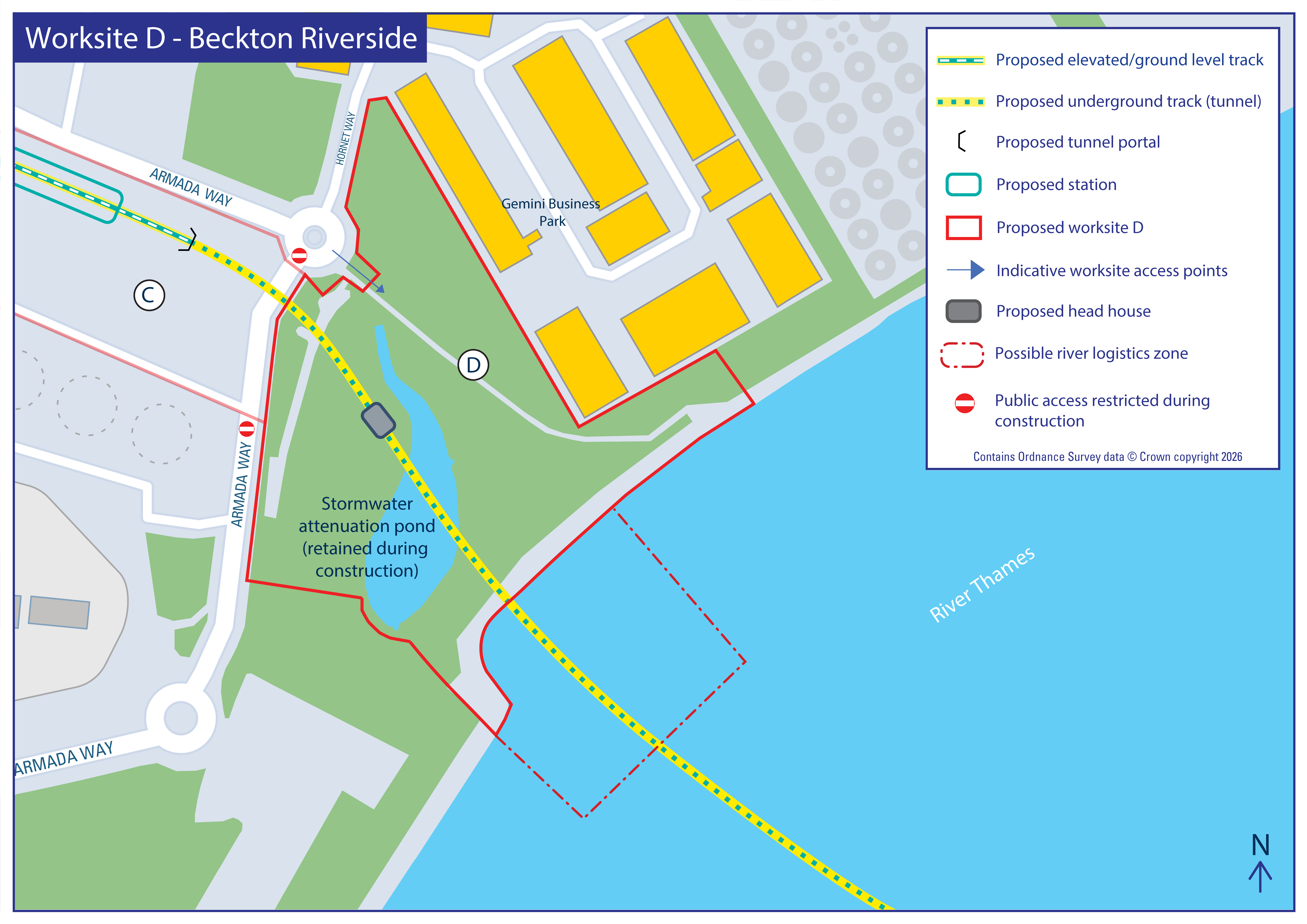
This would be the largest worksite at Beckton Riverside and would be used for tunnelling-related activities such as TBM launch and handling of excavated material.
This work would include:
- Moving major utilities, including gas pipes, water pipes, sewers, and telecoms cables
- Continuing the shallow cut‑and‑cover tunnel from Worksite C
- Building a deep shaft where the TBM would be assembled and launched
- Handling, processing and removing the soil and material dug out during tunnelling
- Constructing a permanent shaft and access facility once tunnelling is complete
As with Worksite C, the same section of Armada Way to the south of the Hornet Way roundabout would need to be temporarily closed to allow construction of the cut-and-cover tunnel. Access to Gallions Reach Shopping Park, Gemini Business Park, and the Beckton DLR depot would be maintained. We would work with local landowners and partners to keep bus services and local traffic moving during construction.
A storm‑water attenuation pond on the site would be carefully protected during construction so it could continue to do its job of managing rainfall and reducing flood risk. The pond would be clearly fenced off to prevent construction vehicles or materials from entering the area, and dedicated routes would guide machinery safely around it.
At this time, we expect to need this worksite for the majority of the construction programme as it would support some of the most intense activities to build the extension.
Road impacts during construction
Construction traffic would mainly use Armada Way and Royal Docks Road, with onward access to the A406 and A13. We have described how each worksite could impact the road network above.
We will work closely with the London Borough of Newham to manage these changes safely for all road users.
We may also need additional changes to the road network or access for abnormal load movements. These are deliveries to site of equipment, for example the TBM, which are heavy and oversized, and need to be done outside of normal working hours when roads are quieter. These movements would be managed and planned with the London Borough of Newham and the Metropolitan Police. The majority of construction would however be done during core daytime hours.
Utilities and other local works
Utility diversion works would be required across all worksites, including around Gallions Reach Shopping Park, Armada Way, and Hornet Way. These would be planned with utility providers and landowners, and full details would form part of our application to build and operate the railway.
Thamesmead
Two worksites would be required on the south side of the river, with indicative locations identified below known as Worksites E and F.
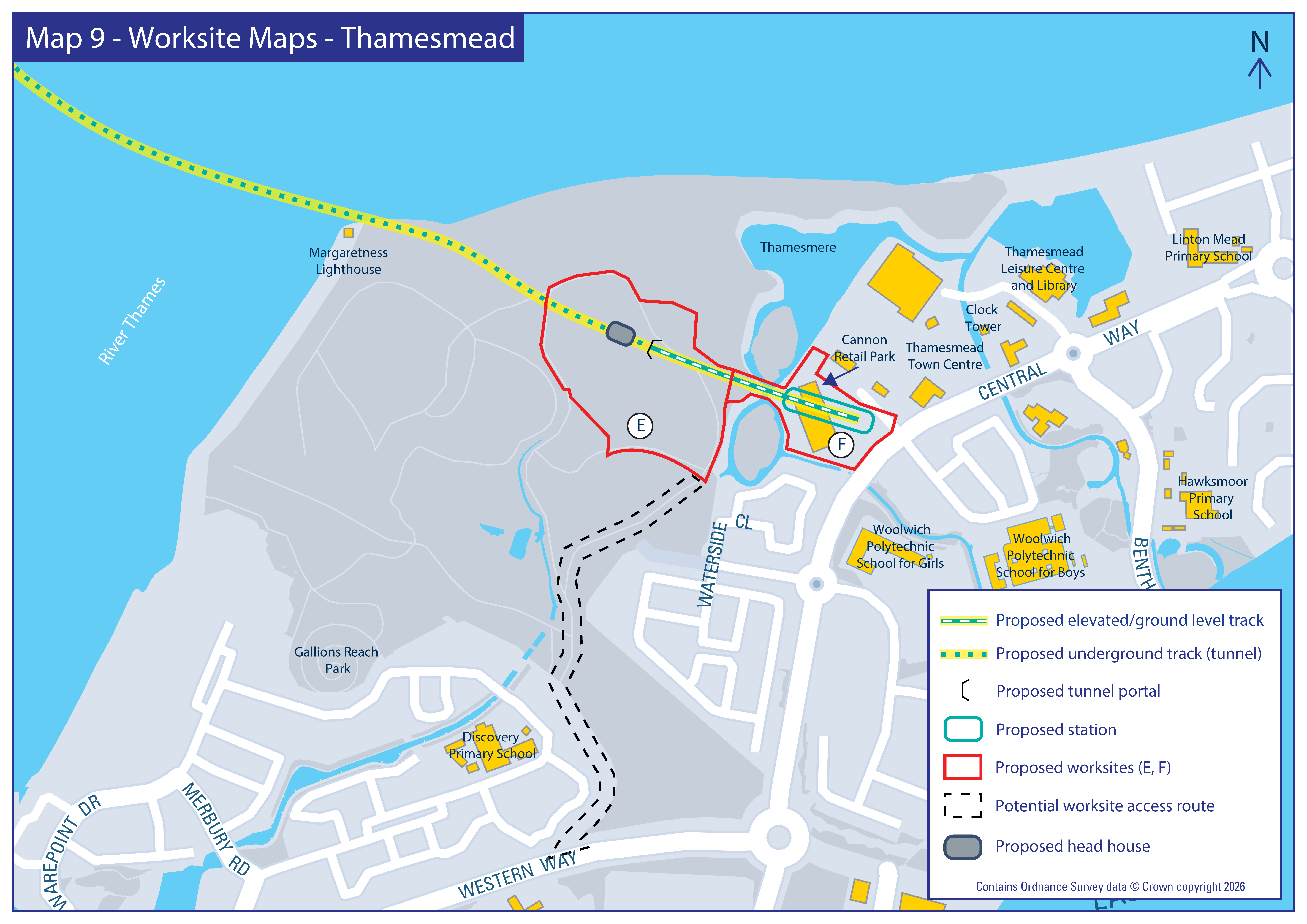
To access these worksites, construction traffic would mainly use roads including Western Way and Eastern Way, both of which form part of the A2016 and provide onward access to the A205, A207 and the A2.
Worksite E
This worksite would be situated within the Thamesmead Waterfront development area, on the former Tripcock Landfill site. This location is not currently accessible to the public and lies to the northwest of Thamesmead town centre.
Please see the proposed worksite boundary below:
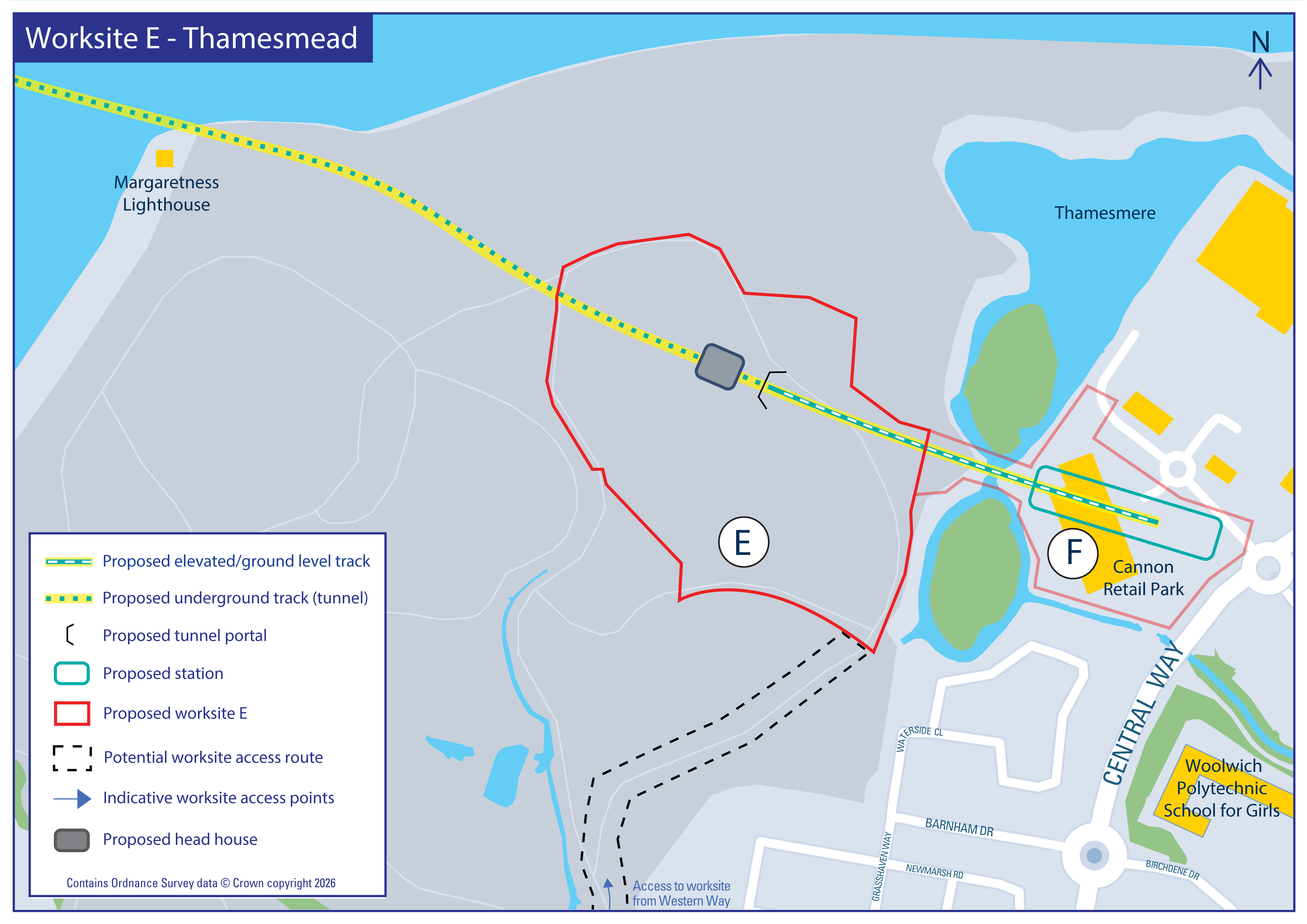
The worksite would be used to continue building the tunnelled section of railway, as well as creating the new structures that would allow the DLR extension to rise to the surface and transition onto the viaduct towards the new proposed Thamesmead station.
Work here would include:
- Receiving the tunnel boring machine arriving from Worksite D, rotating it and then relaunching the machine for the second drive from Thamesmead to Beckton Riverside
- Building a deep tunnel shaft and head house with associated ventilation and maintenance equipment, which would provide future maintenance and emergency access to the shaft and tunnels
- Building the shallow cut-and-cover tunnels and retained cut section that would allow the DLR extension to rise to the surface and transition onto the viaduct
- Installing rail systems
Construction traffic would access the site from Western Way, crossing the Thamesmead Waterfront development area.
At this time, we expect to need this worksite for the majority of the construction programme as it would support some of the most intense activities to build the new extension.
Worksite F
This worksite would be located on the current Cannon Retail Park, accessed by Twin Tumps Way. Construction vehicles would mainly access the site from Twin Tumps Way, with some access shared with Worksite E.
Please see the proposed worksite boundary below:
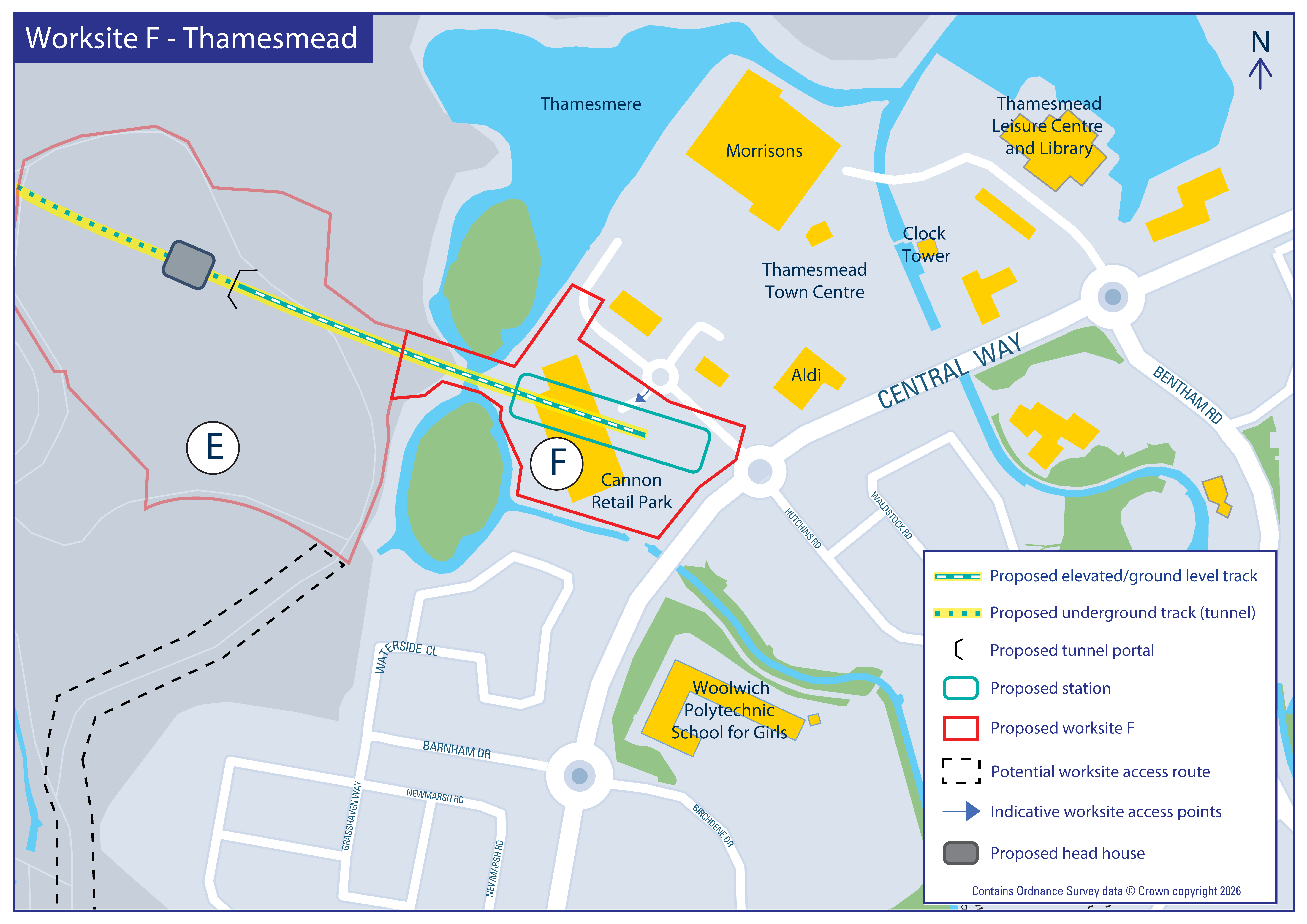
This worksite would be used to build the viaduct section which would connect the cross-river section of the railway and the new station at Thamesmead.
Work here would include:
- Demolishing the existing retail buildings to make space for the new railway infrastructure
- Building the new elevated DLR station
- Building new viaducts on either side of the station to carry the railway
- Installing deep foundations (piling) to support the new structures
- Building viaduct supports and spans
- Fitting out the new station, including platforms and internal areas
Worksite F would be accessed via A2041 Central Way, with construction traffic to this worksite routing via the roundabout junction which connects Western Way, Eastern Way and Central Way rather than via Carlyle Road.
Temporary highway changes during construction are likely to be needed to build the proposed station, along Central Way, and at the roundabout junction which connects Central Way, Twin Tumps Way and Hutchins Road. We would maintain vehicle access to the car parks which serve Morrisons, Aldi, and other facilities situated in Thamesmead town centre, as well as the Morrisons Petrol Filling Station. This would be achieved by putting in place temporary lane closures, traffic management measures, and diversions for pedestrians and cyclists.
Changes to the operation of the junction in the long-term could also be required and we’re working with the Royal Borough of Greenwich, landowners and retailers to understand the safest and most effective layout.
At this time, we expect to need this construction worksite for up to three and a half years.
Utilities and other local works
Utilities works at these worksites would include:
- Disconnection of existing water, gas, and electricity mains at Cannon Retail Park
- Diversion of utilities currently located under Central Way and Twin Tumps Way
- Providing new utilities corridors to the proposed station and permanent shaft, potentially requiring works along Barnham Drive
- Relocation of communications equipment e.g. masts
The map below shows possible diversion routes for these works.
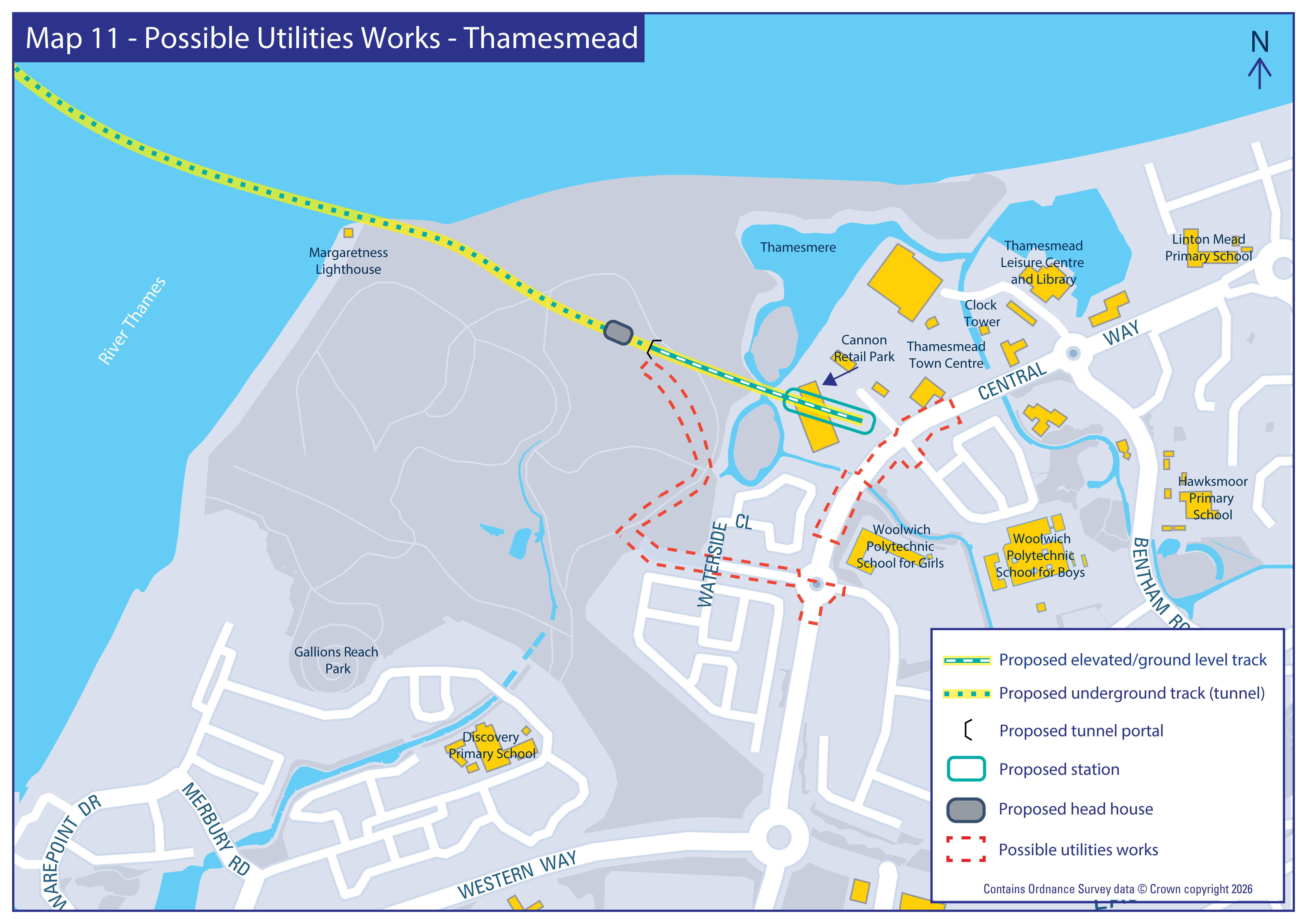
All works would be planned with utility providers and landowners, and local residents would be kept updated, with full details forming part of our application to build and operate the railway.
Landscaping would also be carried out around all sites once the main construction is complete.
Consultation has concluded


