
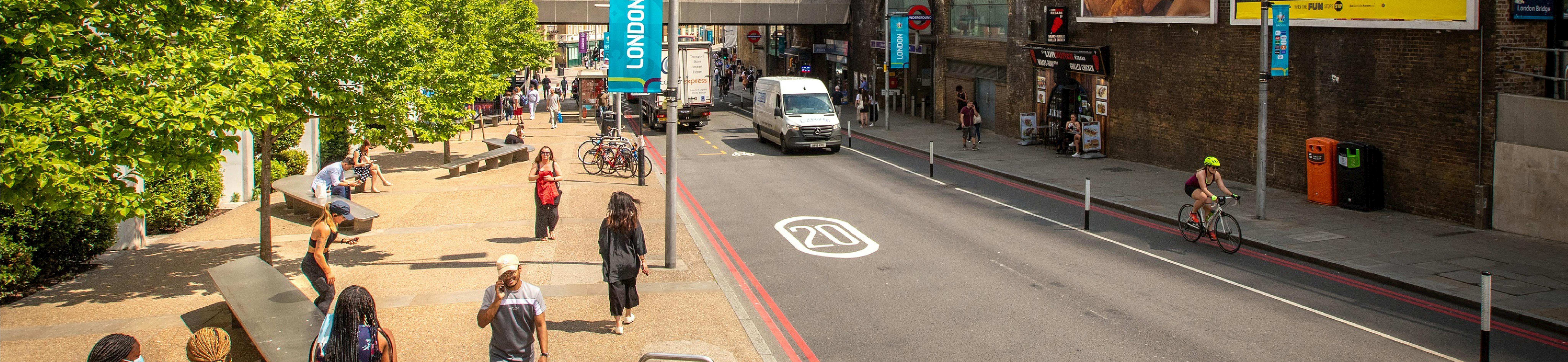
Lowering Speed Limits Programme
The Mayor and Transport for London (TfL) are committed to Vision Zero, eliminating death and serious injury from London’s roads. The Vision Zero Action Plan 2 sets out our ambition and next steps to achieve this. It details our plans to reduce road danger, including proposals to implement safer speeds on the roads we operate and manage across London.
What we are doing
TfL manages the TfL Road Network (TLRN) which is made up of London’s most strategic roads, accounting for roughly 5% of London’s roads. The remaining 95% of London’s roads are managed by local authorities.
In our Vision Zero Action Plan 2, published in March 2026, we committed to ensuring speed limits on the TLRN are consistent, easy to comply with, and appropriate to the mix of road users and context. By 2025:
20mph will be the default speed limit in central and inner London on the TLRN
We will reduce speed limits on TLRN roads where people live, take public transport, or there are side roads without traffic signals, to a default maximum speed limit of 40mph
To deliver this, TfL will lower the speed limit on at least a further 65km of the TfL Road Network by 2030, making over 80 per cent of its roads in central and inner London 20mph
It's also the policy of two thirds of London local authorities to apply a 20mph limit to most of their roads.
We are committed to improving transport in London by making it safe and reliable. All of our plans have been designed with this in mind. Please view our Equalities Statement for more information.
Phase 4 works
Our next phase of works - phase 4 - will commence in early 2027. Seven locations on the TLRN have been selected for this.
The following roads will be reduced from 30mph to a 20mph speed limit:
- London borough of Wandsworth: A217 Swandon Way: (including) Wandsworth Roundabout to Fairfield Street
- London borough of Lewisham: A21 Bromley Road & Bromley Hill: between Sangley Road and Avondale Road
- London borough of Merton: A24 Morden Road (Morden Hall Road to the Junction with Merantun Way) & Merantun Way (between the junction with Christchurch Road to the junction with Morden Road)
- London borough of Croydon: A232 Wickham Road: from the junction with Shirley Road to the junction with Monks Orchard Road
The following roads will be reduced from 40mph to a 30mph speed limit:
- London borough of Hounslow: A406 Gunnersbury Avenue – from Gunnersbury Lane to Chiswick roundabout
- London boroughs of Barnet & Haringey: A1 Aylmer Road/Lyttelton Road (between Aylmer Parade and Blandford Close). The gyratory section of Archway Road/North Hill and Bakers Lane will also reduce from a 30mph limit to 20mph.
- London borough of Redbridge: A12 Eastern Avenue: between Redbridge Roundabout and Ethelbert Gardens
Our work consists of installing new traffic signing and relining the carriageway. The majority of works will be carried out under ‘mobile works’ with minimal impact to road users and pedestrians. In some cases, as a last resort, carriageway and footway closures will be utilised with diversions in place.
Although not part of phase 4, we are also planning to reduce the speed limit from 30mph to 20mph in early 2027 on:
Why we are lowering speeds
Collision data from around the world is very clear. It shows the faster a vehicle is travelling, the more likely a collision will occur because the driver has less time to react, stop or avoid the collision and the more severe an injury resulting from the collision will be.
We recently published a study which examines the impact of over 150 20mph schemes on borough roads in London between 1989 and 2013. Our report – the first of its scale in London – comprehensively demonstrates that 20mph schemes have had a significant positive impact on reducing the number of people killed or seriously injured (KSI) on our roads. It shows that on borough roads where 20mph speed limits were introduced, there was a 34% reduction in the number of people killed or seriously injured (from 395 to 260), compared against the background trend of a 15% fall.
The effectiveness of the Lowering Speed Limits programme on the TLRN so far
Phase 1
Data collected from 1 May 2020 to 30 June 2022 were compared to a similar seasonally-matched period before 20mph speed limits were implemented in the central London Congestion Charging Zone in 2020. The number of collisions fell 25% (from 405 to 304), and collisions resulting in death or serious injury fell 24% (from 94 to 71).
Note - trends should be interpreted with caution because this analysis covers the period including the coronavirus pandemic which may have impacted trends in collisions. Similar analysis has been undertaken (.DOC 111 KB) to exploring the safety impacts of 20mph speed limits on borough roads from 1989 to 2013 which found a 32% reduction in collisions resulting in death or serious injury (from 371 to 252) on 20mph roads compared to a 15% fall in collisions resulting in death or serious injury in the control group (all borough roads within the Greater London Authority area).
The London-wide reduction in collisions resulting in death or serious injury fell around 10% over the same period.
Collision data for the whole of London is provided in CSV extracts on our website every year. See the Road safety data page.
Phase 2
Detailed analysis will be published after three years’ worth of collision data becomes available.
 Type of conversation:
-
 Safety impacts of 20mph speed limit introduction on borough roads in London
-
Safe speeds for central London introducing 20mph speed limits Consultation Report.pdf (519 KB) (pdf)
-
Equalities Statement.pdf (21.6 KB) (pdf)
-
Traffic Accident Data summary.pptx (89.2 KB) (pptx)
-
A3 Service Road_Cons_v2 (FINAL).pdf (1.69 MB) (pdf)

-
LSL_Consultation_Plan_A1_Aylmer_Road.pdf (337 KB) (pdf)
-
LSL_Consultation_Plan_A12_Eastern_Avenue.pdf (365 KB) (pdf)
-
LSL_Consultation_Plan_A21_Bromley_Road.pdf (491 KB) (pdf)
-
LSL_Consultation_plan_A24_Morden Road and Merantun Way.pdf (418 KB) (pdf)
-
LSL_Consultation_Plan_A217 Swandon Way.pdf (292 KB) (pdf)
-
LSL_Consultation_Plan_A232 Wickham Road_Revision A.pdf (394 KB) (pdf)
-
LSL_Consultation_Plan_Gunnersbury_Avenue_Revision A.pdf (274 KB) (pdf)

