Bus route 42 restructure
The consultation period has now closed. You can find updates on the proposals in the 'Latest news' section.
Proposal
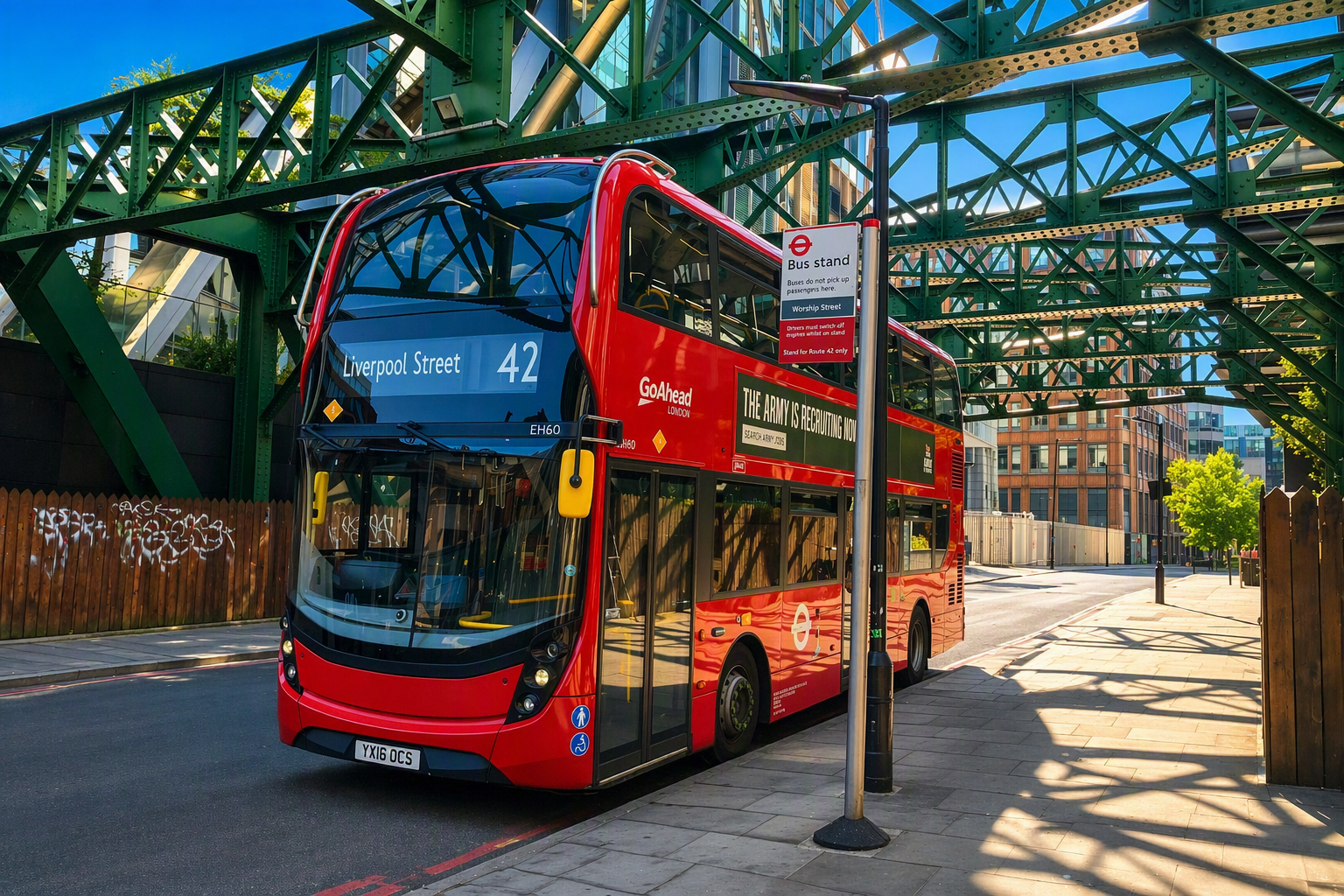 Route 42 bus at Liverpool Street stopBus route 42 currently operates between East Dulwich Sainsbury's and Liverpool Street, with a bus every 15 minutes during Monday to Sunday daytime and every 20 minutes during the evenings.
It is proposed that route 42 would terminate south of Tower Bridge on Tooley Street, standing at Queen Elizabeth Street (south side). To complete journeys, passengers would need to change buses to route 78. Bus route 78 covers the same routeing as bus route 42 between Tower Bridge Road (Grange Road) and Liverpool Street.
Passengers would be able to change buses at the same bus stops on Tower Bridge Road.
To mitigate some of the impacts on passengers, especially during off-peak times, it is proposed on route 42 to:
- Increase frequency to a bus every 20 minutes instead of 30 minutes Monday to Sunday early mornings
- Increase frequency to a bus every 15 minutes instead of 20 minutes Monday to Sunday evenings
Frequency changes are not within the scope of consultation. They form part of our continual review of the bus network which helps ensure services operate more efficiently with the right level of service provided.
If route 42 stops and starts at Tooley Street as proposed, there would be a gap in service on Monday to Saturdays in the early morning. This would be for 40 minutes between 05:00 and 05:40 on the section from Liverpool Street to Tower Bridge Road.
To avoid this, it is proposed to introduce two additional early journeys to operate on route 78 on Monday to Saturday daytimes, scheduled to depart Shoreditch towards Nunhead at 05:00 and 05:20. The route 78 schedule covers all other times route 42 currently operates.
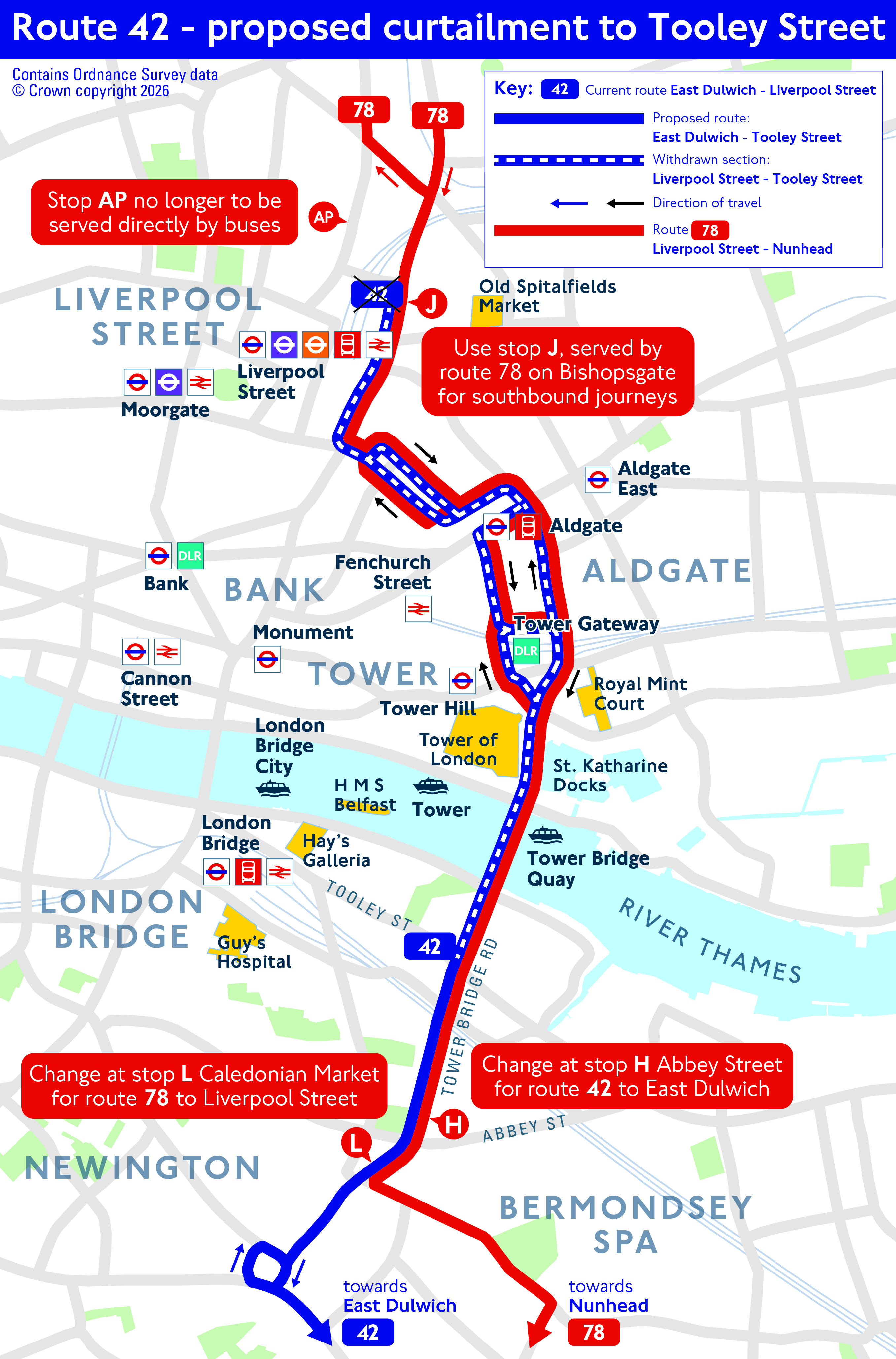 (Click on map for a larger version)
Why
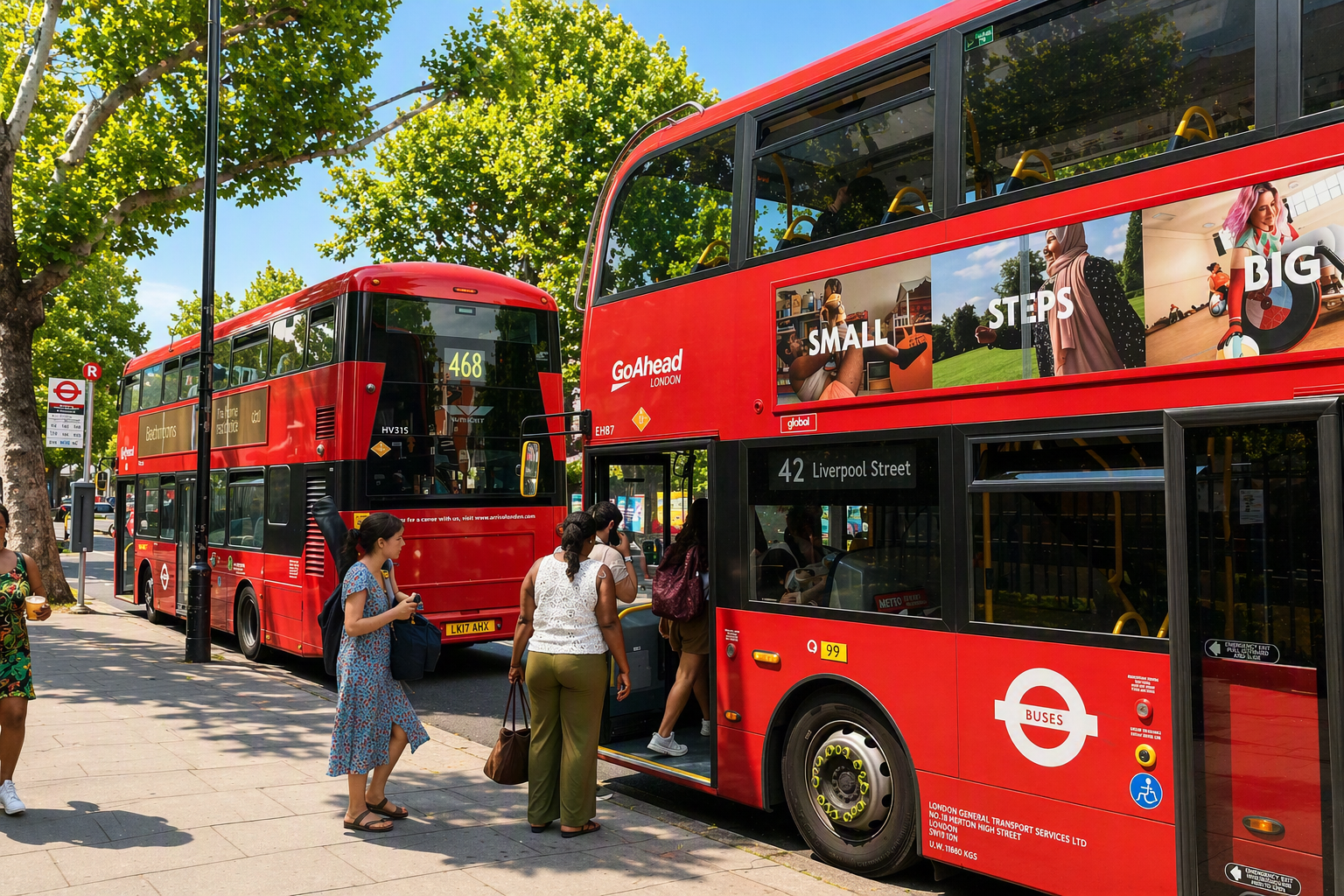 Route 42 bus at stop RBus route 42 is one of the most unreliable on the bus network, suffering from heavy traffic delays and the ad-hoc lifting of Tower Bridge, which can happen many times a day.
As a result of the service being unreliable, passenger numbers have steadily dropped over the past five years with numbers falling by nearly a third since 2021. Approximately 9,600 passengers were using the service in 2019, compared to 2026 with roughly 6,900 passengers now using the service.
We have investigated several ways to try and improve the reliability of route 42. However, all the options have proved too costly to have any impact on operating a reliable route.
Our ambition is for London’s bus network to be the best of any city in the world.
We are taking steps to achieve this, and to ensure that the network is:
- Frequent and reliable across the whole city, reflecting current and future travel patterns
- Inclusive and affordable, with a high-quality customer experience
- Safe and green, supporting both Vision Zero and Net Zero
- Cost-efficient, enabling growth and supporting London’s economy
Our vision for buses
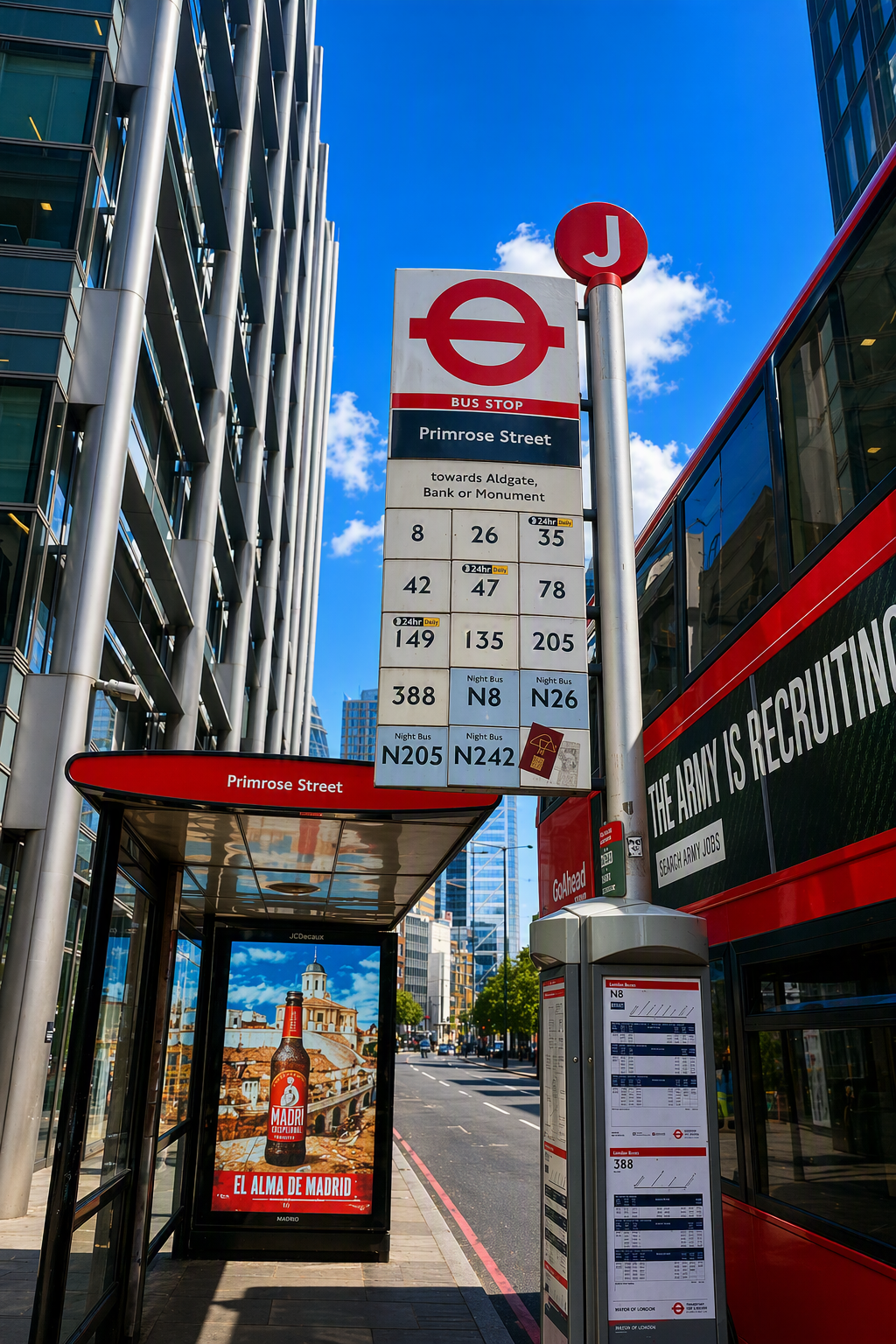 Primrose Street bus stop JLondon is constantly changing and, as our most flexible form of public transport, our bus network must change too. That’s why our 2026 Business Plan builds on our Bus Action Plan by setting out how we will reimagine London’s bus network to ensure it can continue to deliver for the changing needs of Londoners now and into the future. This means providing an attractive, reliable, green bus service for all Londoners which reflects demand and is financially sustainable.
What this means for customers is that we’re going to be consulting on changes to ensure buses run where they’re needed most:
- We will simplify routes in central and inner London, running a smaller number of high frequency, more reliable routes, so that we can deliver an attractive service which is still comprehensive and frequent, but has less duplication and excess capacity. We will seek to minimise any negative impacts, for example by ensuring convenient comfortable and accessible interchanges to help customers easily move around the network in a similar way to the London Underground and the wider rail system
- We will continue to improve connections in outer London by expanding the Superloop network to link town centres and key stations. New connections will help unlock housing growth and encourage even more Londoners to go car free
- While some routes will change, we will minimise any local impacts as far as possible. Our aim is to create a network that’s easier to understand and better reflects how people travel today
Alongside bus route changes, we’re also taking action to tackle congestion on bus corridors to make passenger journeys quicker and more reliable. This includes:
- Rolling out world-leading FUSION technology to give buses priority at junctions and traffic signals
- Partnering with boroughs and coordinating roadworks
- Cutting delays to buses through our pan-London lane rental scheme, which charges utility companies for how long they take to carry out roadworks, so streets are reopened more quickly
- Investing £90m a year to improve borough roads, making them safer and better for buses and those walking and cycling
- Targeting £30 million through our Better Bus Partnerships to improve whole bus corridors, cutting delays and making journeys quicker and more reliable in Haringey, Lewisham and Southwark
- Trialling AI cameras on buses to identify delay hotspots. Using the intelligence gathered to better understand the impact of roadworks and traffic contraventions, improve enforcement and reduce delays to buses
At the same time, we’re rolling out improvements to enhance customer experience for those using our buses, making them greener, safer, and more comfortable. This includes:
- Delivering the next iteration of our world-leading Bus Safety Standard, which ensures new buses in London are fitted with advanced safety features such as intelligent speed assist and camera monitoring systems
- Ensuring that customers have up-to-date information, where they need it, by installing 5,000 additional real-time information displays at bus stops
- Delivering next-generation bus shelters at more locations, with better lighting, seating and accessibility
- Building on Western Europe’s largest zero emission bus fleet, with up to 6,000 zero emission buses in service by 2030, the equivalent of two entering service every day
- Improving passenger confidence and safety with our trial of CCTV at 30 bus shelters to evaluate the feasibility of a wider introduction
- Investing in bus driver training to support a better and consistent customer experience
- Improving bus station layouts to improve safety, accessibility and customer experience
How it impacts you
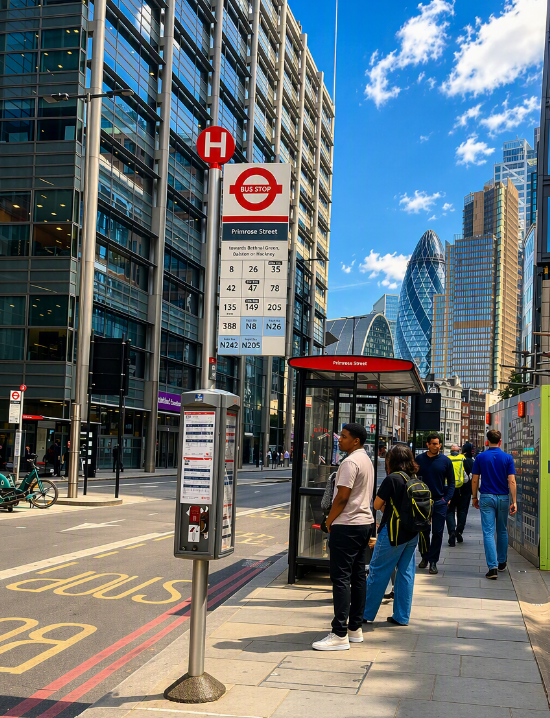 Primrose Street bus stop HFor southbound journeys, same-stop interchange would be available between routes 42 and 78 at Stop H “Abbey Street” on Tower Bridge Road. A shelter and seating are available at Stop H.
For northbound journeys, same-stop interchange would be available between routes 42 and 78 at Stop L “Grange Road /Caledonian Market” on Tower Bridge Road. A shelter and seating are available at Stop L.
Passengers would be able to make the same journey by using route 78 instead of route 42 between Tower Bridge Road (Grange Road) and Liverpool Street Station except for stop AP on Appold Street. A total of 177 passengers board or alight at stop AP on Appold Street, which would no longer be directly served by buses but is within 230 metres of the alternative stop on Bishopsgate, served by route 78.
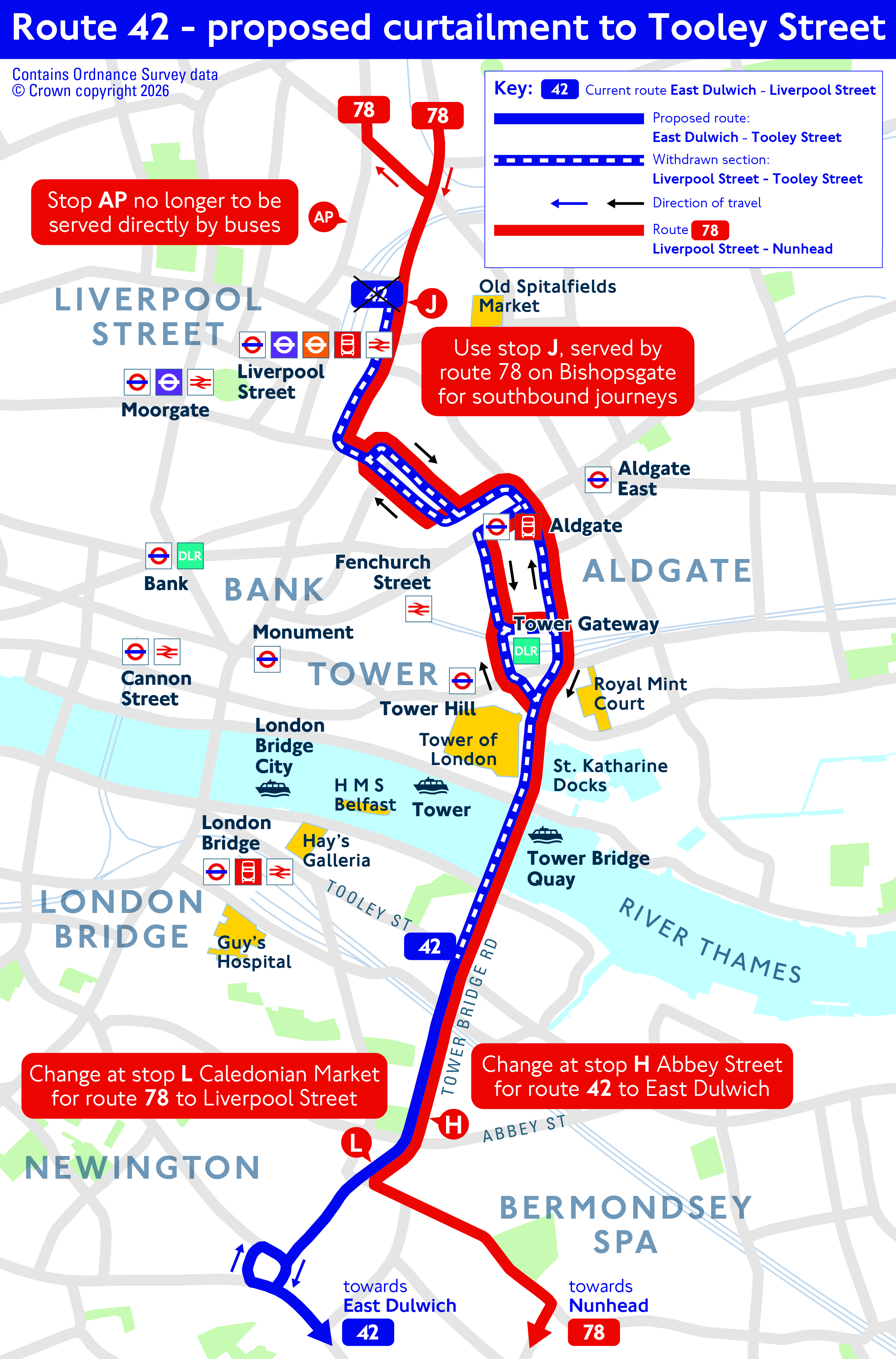 (Click on map for a larger version)
We’ve completed an initial Equality Impact Assessment (EqIA) to understand how different groups may be affected. This has highlighted that passengers who are elderly, female or have various different needs could be negatively impacted by the proposal as they may need to change buses to complete journeys. There are mitigations in place for most of the impacts. However, we know from previous similar proposals that people do not like changing buses.
By simplifying the network and tackling delays, we can deliver quicker, more reliable journeys, use funding more efficiently, and make buses a more attractive alternative to driving. This approach will help create a greener, more sustainable bus network that reflects how Londoners travel today and supports the city’s future.
More information
We have also provided more information to help you respond and a set of Frequently Asked Questions:
Accessible information
We want to make sure everyone can take part in our consultations. To help make it accessible to everyone we have provided our consultation information in the following formats:
 British Sign Language
 Easy Read
 Audio files
Translation
You can also translate the information on this page into another language by using the ‘Select language’ button at the bottom of the page
British Sign Language
To further enhance how we consult with London's deaf community have provided British Sign Language (BSL) videos of our proposals and survey:
BSL video of our proposals
 We are delighted to enable British Sign Language users to contact us using a British Sign Language video interpreter, via the Interpreters Live service, provided by Sign Solutions. Please click the image to connect now.
Easy Read
Audio files
Tell us your views
You can reply by completing our survey, which should take no more than 10 minutes to complete or if you are short on time, you can submit a quick response.
 |  |
The closing date for comments is Sunday 20 September 2026.
Questions?
You can use our question tool during the consultation period. We will respond to your questions as soon as we can.
You can also contact us by email, via our telephone call back service (020 3054 6037) or in writing (FREEPOST TFL HAVE YOUR SAY).
Latest news
Update 22 September 2026
This consultation has now closed. Thank you to everyone who responded. We are analysing your feedback and will report back shortly.
The report will be available to everyone that takes part in the consultation and a copy will be published on our website.