

Beckton Riverside
This page summarises the potential environmental impacts in Beckton Riverside. All impacts outlined below will undergo further evaluation through the Environmental Impact Assessment (EIA) process, during which appropriate mitigation measures will be developed. As such, these impacts should not be considered definitive at this stage.
Existing environmental conditions
Beckton, including the Beckton Riverside area has been shaped by over 100 years of industrial use. Since the 1980s, the area has begun to change. New homes, community buildings, and the DLR have been built, although parts of the old industrial landscape can still be seen, especially along the river.
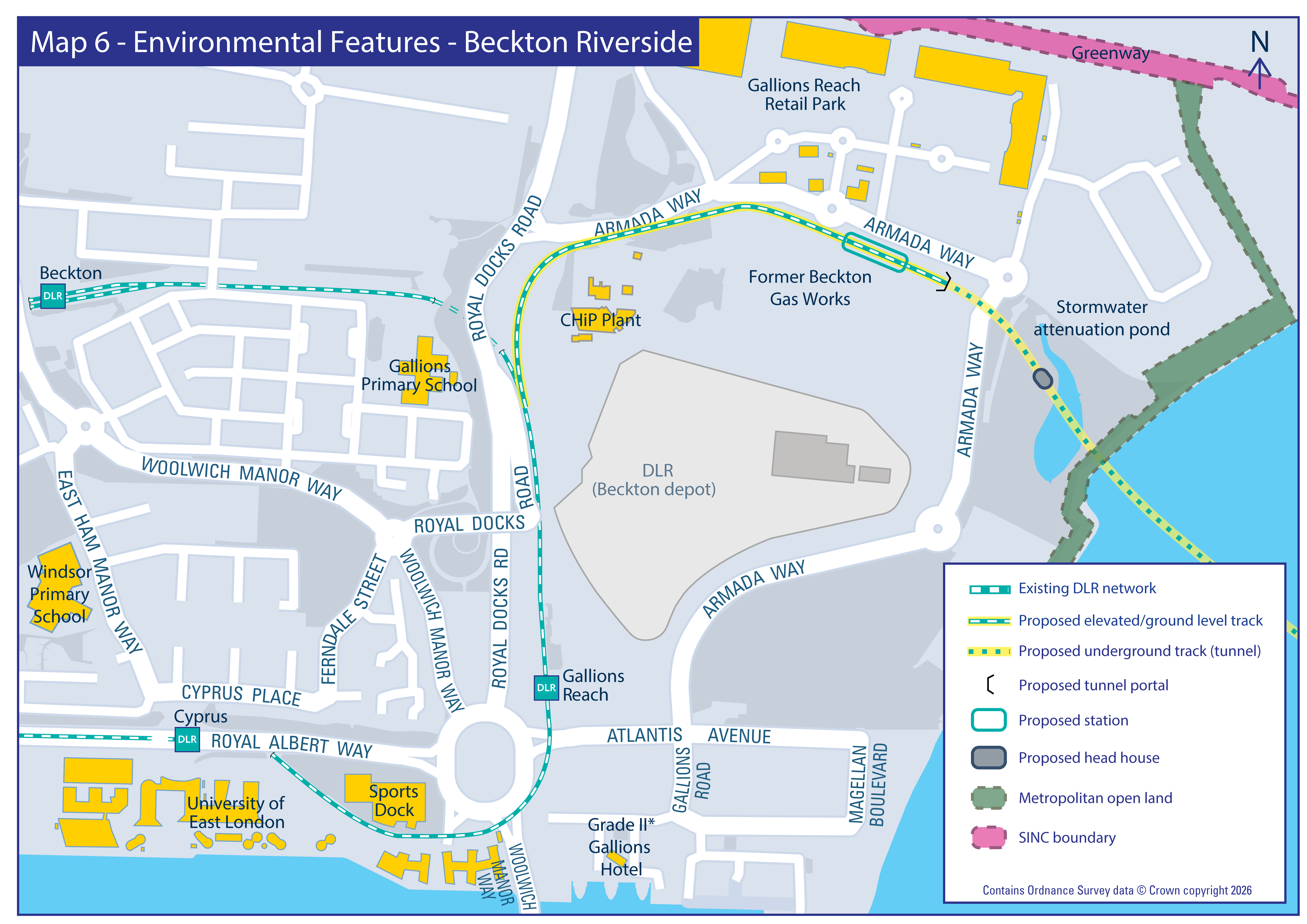
Today, Beckton Riverside is part of the Royal Docks and Beckton Riverside Opportunity Area. Much of the land is underused and has significant potential for redevelopment.
Important features include:
- Retail and restaurants at Gallions Reach Shopping Park and Beckton Gateway Retail Park
- Former Beckton Gas works site and the existing DLR Depot
- Gemini Business Park and Beckton Sewage Treatment works
- Residential communities within the wider area including schools and the University of East London
The local environment in and around Beckton is influenced by:
- Road traffic from Royal Docks Road and Armada Way
- Air quality levels are influenced by nearby major roads, including the A13 and A1020
- Noise comes mainly from existing road traffic, the existing DLR line, and aircraft using London City Airport
- Local habitats include parks, waterways, planted areas, and land that is slowly returning to a more natural state
Potential changes during construction
Construction of the scheme would take place across four proposed worksites in Beckton Riverside. We have provided information about these here.
Transportation of materials to, or from the worksites may take place using roads only, or with support from the river (for example, moving materials by boat) or rail. In either case, some short‑term changes are likely.
Community and people
During construction, people may notice:
- Introduction of additional heavy goods vehicles (HGVs) on main roads associated with construction movements, which could potentially make streets feel busier and less pleasant for walking
- Changes to road layouts which could temporarily affect access to local shops, places to eat, and how people experience the area
- Visible construction activity, including temporary worksites, machinery, and structures. These would be especially noticeable near Armada Way and Royal Docks Road
- Potential temporary impacts from noise, vibration, and air quality caused by activities such as piling foundations into the ground, digging, and moving materials although there would be control measures in place to reduce any impacts
- Possible disturbance to archaeological remains, as Beckton is an Archaeological Priority Area, meaning there is a higher chance of finding remains from the past
- Temporary changes to walking and travel routes, which could be harder for people with limited mobility or those who rely on familiar, predictable routes
- A more visible and concentrated period of activity along the riverside, including piling works, crane operations, construction lighting, and vessels moving materials on the river
Green environment (plants, animals, and water)
It is possible that there may be temporary impacts on the local environment. This may result in temporary changes in conditions near sensitive habitats.
Construction could lead to:
- Temporary construction dust settling on plants, including nearby Priority Habitat woodland
- Temporary disturbance to wildlife, especially animals using roadside grass, trees, and the balancing pond area
- Small indirect effects on nearby protected nature sites, such as slight changes in air quality or groundwater
- Restrictions due to flood risk areas, meaning flood storage space must be carefully planned
- Below‑ground works disturbing buried materials in the ground, which would need careful management to avoid harm to the environment
- Short-term changes to groundwater movement caused by tunnelling or deep foundations
Brown environment (land, soil, and past industry)
Beckton has a long industrial history associated with the former gasworks and other industrial activities. Therefore, construction could lead to:
- Digging potentially uncovering contaminated soil or old industrial remains
- Likely presence of ground gases or historic pollutants which would need to be safely controlled
- Rainwater runoff potentially increasing if soil becomes compacted or waterlogged during works
- Waste from excavation and construction will need careful handling and disposal
- Emissions from construction vehicles, both on roads and the river, potentially increasing along certain routes (but only for a limited time)
Potential impacts once the scheme is operating
Community and people
After construction is complete:
- A new station and transport would create new links in the area, connections to other public transport services such as the Elizabeth Line and links to east and central London which would make it easier to reach jobs, schools, and services
- Land use will change, with the new station helping support redevelopment of the local area and the creation of a new town centre, as well as improve how people move around the area
- Permanent structures will change views, but over time they are expected to become a normal part of the local landscape
- Reduce car use by providing a high-quality public transport option, supporting a shift towards more sustainable transport and lower carbon emissions. Operational noise from trains is expected to be regular and predictable, making it easier to manage
- Archaeological remains will be protected, as no further ground disturbance is expected
Green environment
Longer term environmental effects are expected to be small and there is opportunity to create new areas which support local habitats:
- Wildlife is likely to adapt to regular and predictable train movements
- Green spaces and habitats should continue to function normally with landscaping and maintenance measures kept in place
- Surface water systems will control rainwater runoff from raised tracks and structures
- Groundwater levels and flood risk are expected to settle back to stable conditions once construction ends
Brown environment
Once operational:
- Very little ground disturbance would occur
- Existing contamination would be either remediated or contained safely beneath new structures
- Routine maintenance will produce small amounts of waste, handled through normal operating procedures
- Reduced road traffic may lead to lower pollution levels over the long term
Mitigation and management measures
Construction will follow a Code of Construction Practice which sets rules that controls how construction is carried out to reduce impacts and sets out the approach to environmental management of potential impacts.
Our Code of Construction Practice is currently in development but is likely to include:
- Require our contractors to achieve FORS accreditation and strictly adhere to Direct Vision Standards as part of our commitment to Vision Zero safety standards
- Require that are contractors are registered with the Considerate Constructors Scheme
- Controls on noise, dust, traffic, and lighting
- Archaeological surveys and protection
- Water management and flood protection measures
- Ecological management of sensitive areas during construction, careful vegetation management and working methods
- Emergency plans and pollution prevention measures
We are also developing our plans for other environmental improvements for example, Biodiversity Net Gain, which aims to restore and enhance the environment to a level better than it currently exists.
Measures we could implement include:
- New planting of native species supporting healthy habitats and ecosystems
- Nest boxes and bat roosts
- Structures that support insects and other small wildlife
- Enhancing existing watercourses to support wider species such as birds
The EIA will make a full assessment and confirm whether any significant environmental effects are likely and identify any specific suitable mitigation measures.
Consultation has concluded


