259, 279 and 349 bus routes - proposed changes in North London
Consultation has concluded
The consultation has now closed, and we have published our consultation report.
After reviewing all responses, we have decided to proceed with the proposed changes. This includes withdrawing route 349 and changing routes 259 and 279 to better match services to current travel demand. We have also made some improvements following feedback, including better interchange at Holloway and increased frequency on route 259 in the early morning period to make journeys easier.
For more information, please visit the ‘Latest news’ section.
Proposals
We are proposing to change the start and end of routes 259 and 279 and to withdraw route 349. Below is a map showing the proposals for routes 259, 279 and 349. Underneath the map you can find more details about the proposed changes.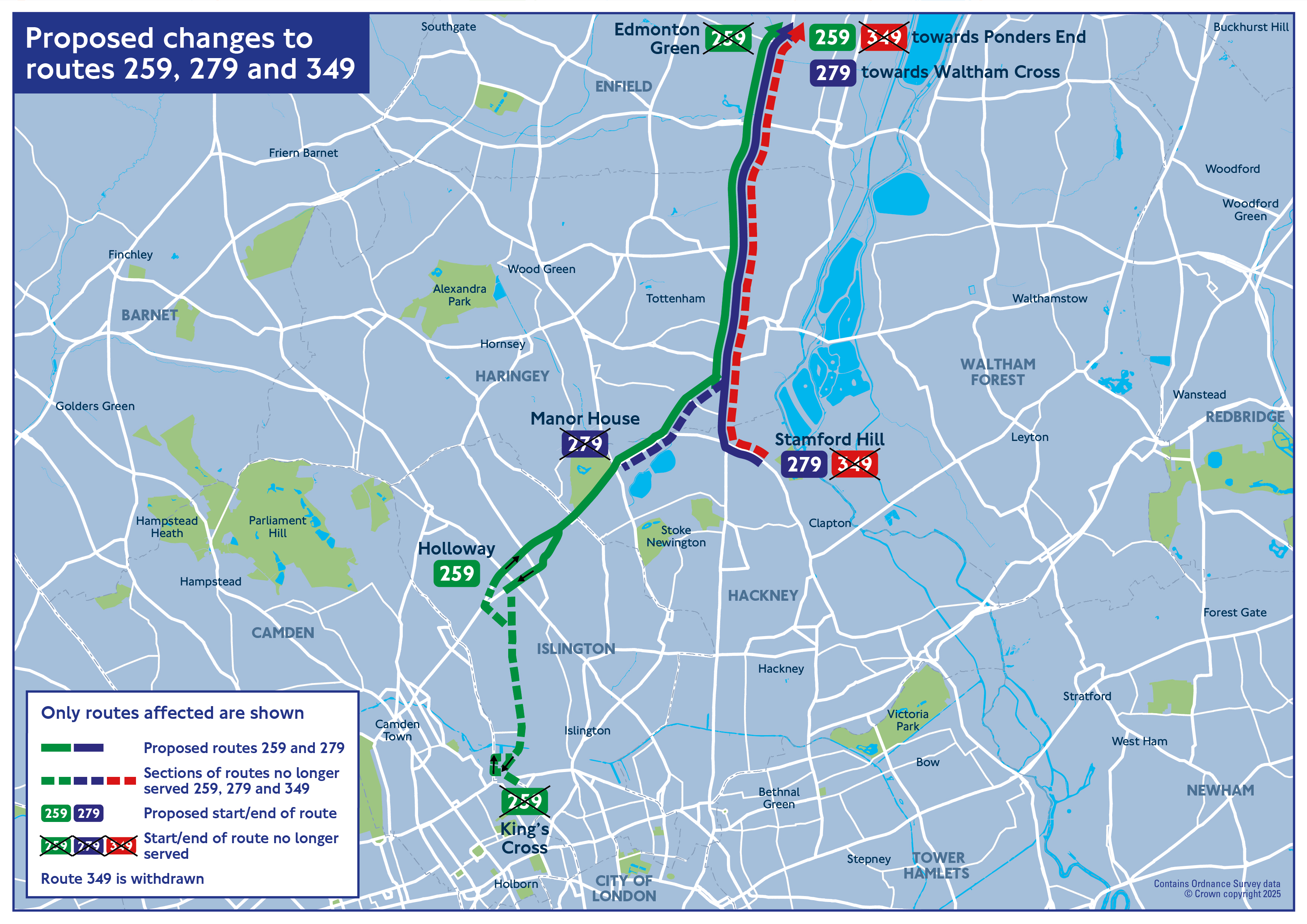
Current Route: Operates between Edmonton Green and King's Cross.
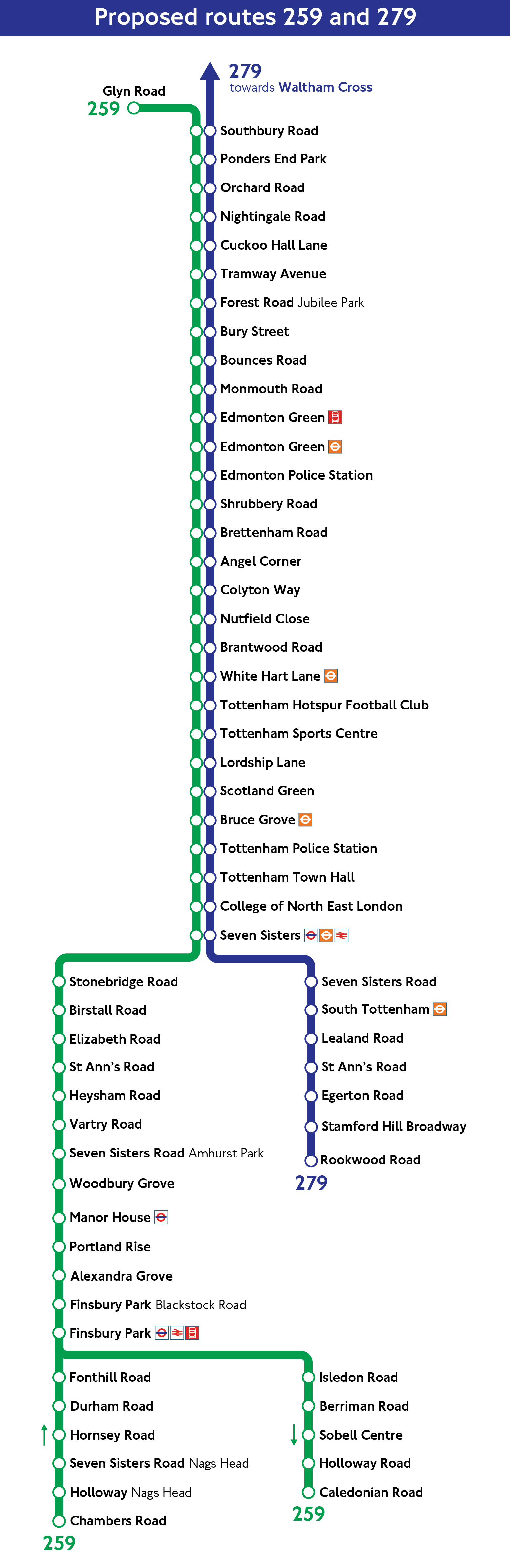
Proposed Route: Re-structured to run between Ponders End and Holloway, Nag’s Head.
This introduces a new direct link between Ponders End and Holloway, providing new access between Enfield and Islington, and reduces duplication with other services on Caledonian Road.
Some passengers may lose direct links to King's Cross and Caledonian Road and need to interchange. There could be potential increase in demand on remaining services south of Holloway.
Route 279 proposed restructure
Current Route: Operates between Waltham Cross and Manor House Station.
Proposed Route: Re-structured to run between Waltham Cross and Stamford Hill.
This maintains strong north-south connectivity through Tottenham and Stamford Hill. It also reduces duplication with other routes on Seven Sisters Road and helps to better match levels of service with passenger demand.
Some passengers may lose direct access to Manor House and Seven Sisters Road, requiring interchange with other services for connections to and from these areas.
Route 349 proposed withdrawal
Current Route: Operates between Ponders End and Stamford Hill.
Proposal: Withdraw the route entirely.
Route 349 overlaps significantly with other services. Withdrawing the route simplifies the network by reducing duplication with other routes and better matches levels of service with passenger demand.
Some passengers will need to use alternative routes (e.g. revised 259 or 279) and may need to interchange.
The map below shows the proposed 259 and 279 routes.
Why?
Surplus capacity has been identified on the A10, the A1010, Seven Sisters Road, and Caledonian Road.
These proposals aim to:
- Remove underused services and duplicated routes
- Introduce new journey opportunities
Buses in London
London’s bus network is our most affordable, accessible, and available form of public transport and offers the main sustainable alternative to cars for those journeys that cannot easily be walked or cycled. It is also London’s most flexible mode of public transport.
We continuously review and adapt the bus network to reflect changing customer needs. This includes proposing changes to existing bus routes, so services operate in areas where our customers need them most. This includes key locations in London where bus services are already popular and are heavily relied on by local communities.
Read more about how we are increasing the number of bus journeys by making bus travel better, faster, and greener in our Bus action plan.
How it impacts you
The proposed changes to routes 259, 279, and 349 would improve connectivity for some passengers, but they would result in disruption for others. Here's what you can expect:
- The restructured routes will provide new direct links between areas such as Ponders End, Holloway, and Stamford Hill, improving access to shopping, employment, and transport hubs
- Simplifying routeings will make the bus network easier to understand and navigate, particularly for new or occasional users
- Some passengers who currently undertake direct journeys, particularly those using route 259, may need to change buses to complete their trips. For example, passengers travelling between Tottenham and King’s Cross may need to change between the revised route 259 and route 17 or 91 in future
We’re working to reduce these impacts by planning the network so that passengers can easily transfer between services at key locations like Bruce Grove, Edmonton Green, and Holloway. If we go decide to go ahead, we will provide detailed maps, journey planning tools, and travel mentoring to help passengers understand and adapt to the changes. We have completed an initial Equality Impact Assessment (EqIA) which sets out the expected impacts on different groups of people.
More information
This consultation gives you the opportunity to learn more about our proposals and to share your thoughts and feedback. We want to hear from you. Whether you’re a regular bus user, a local resident, a business, or someone who may be affected by the changes. Your views will help us understand the impacts and shape the final plans.
We have provided more information and a set of frequently asked questions to help you respond:
Accessible information
We want to make sure everyone is able to take part in our consultations. To help make it accessible to everyone we have provided:
You can translate the information on this page into another language by using the ‘Select language’ button at the bottom of the page
Connecting with London's deaf community on our consultations
To further enhance how we consult with London's deaf community we offer:
- British Sign Language (BSL) videos of our proposals and survey
- A BSL conversation service. This allows the TfL consultation lead to have a two-way BSL translated discussion with a BSL user. To request a BSL conversation please contact us at haveyoursay@tfl.gov.uk and we will be in contact to arrange a convenient time
Tell us your views
You can reply by completing our survey, which should take no more than 10 minutes to complete or if you are short on time, you can submit a quick response.
 |  |
The closing date for comments is 23 January 2026.
Questions?
You can use our question tool during the consultation period. We will respond to your questions as soon as we can.
You can also contact us by email, via our telephone call back service (020 3054 6037) or in writing (FREEPOST TFL HAVE YOUR SAY)
Latest news
Update 26 June 2026
We have now published our consultation report and confirmed our decision to proceed with changes to routes 259, 279 and 349.
After reviewing all responses, we have decided to proceed with the proposed changes. This includes withdrawing route 349 and changing routes 259 and 279 to better match services to current travel demand. We have also made some improvements following feedback. Rather than terminating on Camden Road, route 259 will continue to the northern end of Caledonian Road, serving Stop V. This change will allow a straightforward same-stop interchange for southbound passengers between route 259 and routes 17 and 91, making onward journeys easier and more intuitive. In the northbound direction, route 259 will also serve stops E, F and G on Hillmarton Road, helping to maintain access to this area and ensuring that local connections remain strong and reliable. Together, these improvements are designed to respond to concerns raise during the consultation and make journeys smoother, more joined-up, and easier to navigate for everyone using the network. We will also provide increased frequency on the 259 route to in the early morning period to make journeys easier.
We will now move forward with implementing the changes to the bus network. These changes are expected to take place from early September 2026, following final operational planning.
Thank you to everyone who took part. A detailed summary of the issues raised, along with our responses, is included in Appendix A of the report.
We will continue to work closely with local boroughs and stakeholders as the changes are introduced. Further details will be shared with customers ahead of implementation.
- update ends -
If you have any questions about the scheme, you can ask us here and we will get back to you.
Please note that any questions you ask may be visible to others and will be subject to moderation. Any personal information will be kept confidential but your user name will be displayed. Further details on moderation are available here and privacy here.