West London Orbital
The line would form a new part of the London Overground and is intended to make travelling around the west of London more convenient.
Please use the buttons below to find out more about our plans, including the route, new stations, our plans for the existing stations and how the proposals may impact you and your local area. You can also find out how to ask questions and find further information, including in accessible formats.
The feedback you give will help us decide how to develop our proposals further, and understand and respond to issues that are raised.
The consultation will be open until 18 November 2026.
Why a West London Orbital?
We’re developing proposals for a new rail service, the West London Orbital (WLO). It would be a new London Overground service. It is proposed to run between Hounslow and Hendon, making use of existing rail lines that are currently underused - including the Dudding Hill line, which is currently only used by freight services.
The service would serve a mix of new stations and upgrades to current ones. The proposed new stations are:
- Neasden
- Harlesden
- Old Oak Common Lane
- Lionel Road
Some existing stations would need new platforms, entrances or other upgrades to support the WLO service. You can read more about the new stations by using the 'Stations' button above.
You can read more about the proposed route and why we chose it by using the 'Route' button above.
This new service has the potential to make travelling across west and northwest London much easier. We’re looking for your views to help shape these proposals.
Why is it called the "Orbital"?
The WLO would run around London rather than straight into the centre, forming a kind of arc through west and northwest London. This orbital route makes it quicker and easier to travel between outer London areas without changing in central London.
What would the WLO do?
Improve connections across West London
Parts of west London don’t currently have convenient rail links or attractive alternatives to car use. The WLO would change this by creating new direct services between key town centres and growing places - including Opportunity Areas, which are parts of London identified in the Mayor’s current London Plan as having significant potential for new homes, jobs and infrastructure. Opportunity Areas that could significantly benefit from the WLO include:
- Old Oak and Park Royal
- Brent Cross and Cricklewood
- Wembley
- Burnt Oak and Colindale
- Heathrow
- Great West Corridor
This means more efficient, active and sustainable travel options for local and growing communities.
Support new homes and jobs
Improved public transport helps unlock new homes and employment opportunities. The WLO has been designed to support planned growth across the area, connecting people to new housing, workplaces and town centres.
Improve transport capacity
As London’s population and economy grow, the transport network needs to grow too. The WLO would give people more frequent services and travel choices, provide increased accessibility, relieve pressure on busy rail and road routes, and improve the resilience of the wider network.
Provide environmental and social benefits
The WLO aims to:
- Provide better public transport which could help cut road emissions by providing an alternative to car journeys, supporting net zero and climate change ambitions
- Improve access to jobs, education and local facilities such as healthcare
- Provide better connections for communities that currently have fewer sustainable transport options
- Improve access to leisure and cultural opportunities
- Improve local environmental quality
These benefits support a healthier, greener and fairer west London.
You can read more about the business case for the scheme here.
How these proposals were developed
We’ve designed the route to make good use of existing rail corridors. This helps reduce disruption, keep construction impacts low and ensure good value for money.
We’ve been working closely with the London Boroughs of Barnet, Brent, Ealing and Hounslow, the West London Alliance and the Old Oak and Park Royal Development Corporation on these proposals, as well as Network Rail and other development partners.
This consultation is designed to help us understand whether the WLO proposals meet the needs of local communities, gather feedback on potential stations and the proposed route, and identify issues we need to explore further as designs develop. Your views will help shape the next phase of work. There will be more opportunities to comment through future public consultations and engagement as the project progresses.
Route
The Proposed Route
The WLO would fill a major missing link in west and northwest London, making it much quicker and easier to travel using public transport without going through central London.
It would connect key growth hubs including Brent Cross, Neasden, Old Oak Common, the Golden Mile and Hounslow. This means faster links to jobs, education, new housing and regeneration areas.
Route Summary
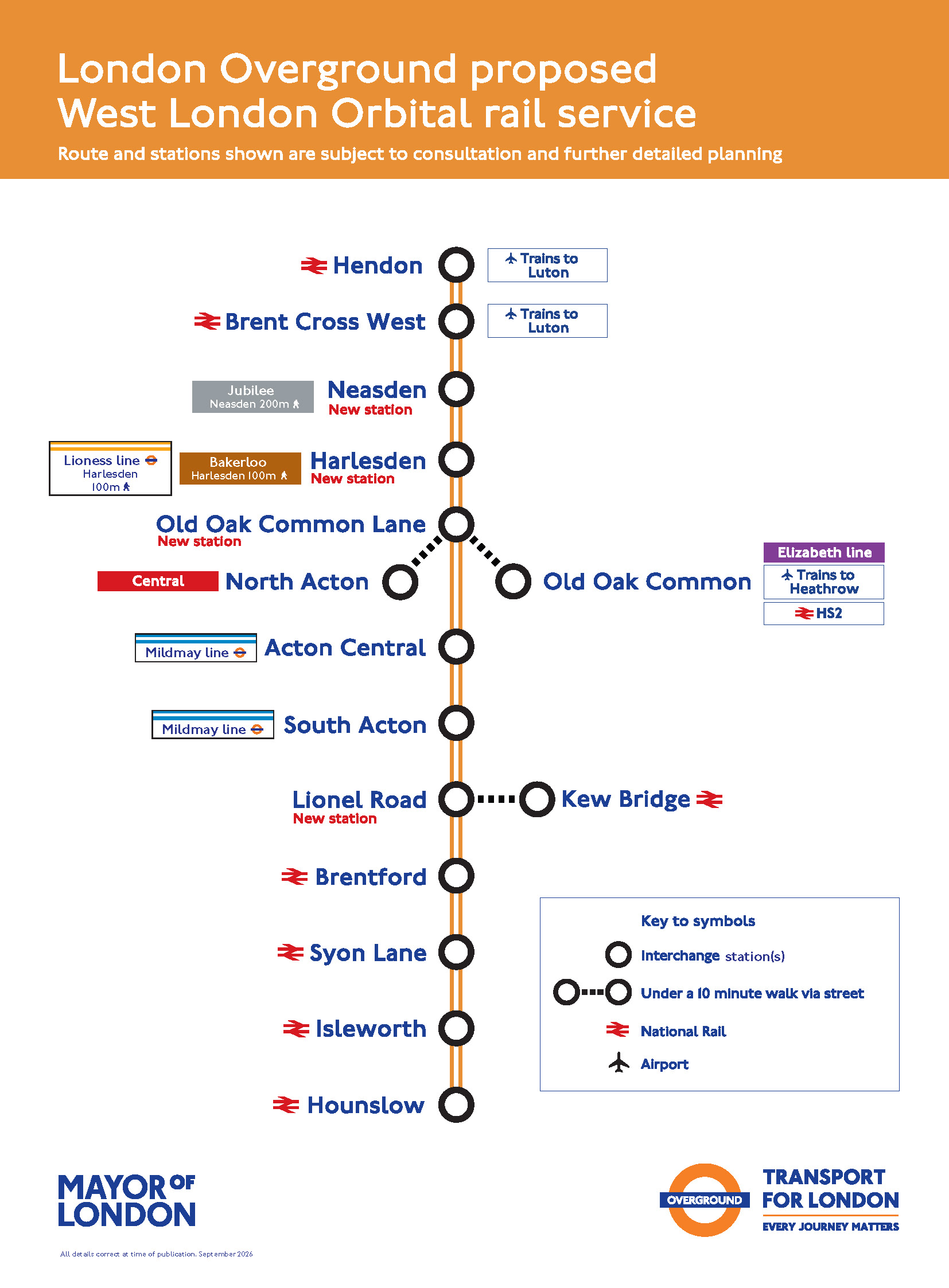
Hendon → Brent Cross West
The northernmost WLO station would be Hendon, with new platforms on the existing freight lines there.
Trains would then continue south to Brent Cross West, using new dedicated platforms.
Brent Cross West → Old Oak Common Lane (via the Dudding Hill Line)
This part of the route would use the Dudding Hill Line, currently used only by freight trains. The WLO would introduce passenger services for the first time in over 100 years.
New stations would be created at:
- Neasden
- Harlesden
- Old Oak Common Lane
All three would provide short walking interchanges to nearby Tube or rail services.
Old Oak Common Lane → South Acton
South of Old Oak Common Lane, WLO trains would join the same tracks used by the existing Mildmay line, stopping at Acton Central and South Acton.
South Acton → Hounslow
The route would then switch briefly onto another freight line through Chiswick, including a new station at Lionel Road. After Lionel Road, trains would join the Hounslow Loop, stopping at Brentford, Syon Lane, and Isleworth. The southernmost station would be Hounslow.
Interchange opportunities
The route would create improved connections to other parts of the public transport network:
- Hendon and Brent Cross West stations would have quick and easy same-station interchanges onto Thameslink services
- The existing stations at Brentford, Syon Lane, Islewoth and Hounslow would have easy same-station interchange with South Western Railway services
It would also create new interchange opportunities - these would require a short walk to a nearby station:
- Neasden - short street level walk to Jubilee line
- Harlesden - short street level walk to Bakerloo and Lioness lines
- Old Oak Common Lane – short walk to new HS2, Elizabeth Line and Great Western Railway station. The Central Line at North Acton would also be a short walk away
- Lionel Road - a short walk to South Western Railway services at Kew Bridge station.
The WLO would be an important feeder route into what will become one of London’s busiest rail hubs at Old Oak Common.
How we chose this route
We analysed a wide range of transport options. The best-performing solution was a London Overground service running between Hounslow and Hendon, with four to six trains per hour. It uses existing rail lines, connects key growth areas, and provides the best balance of cost, benefits and reliability.
You can read more detail about how we arrived at our proposed route here.
Potential future options - West Hampstead branch
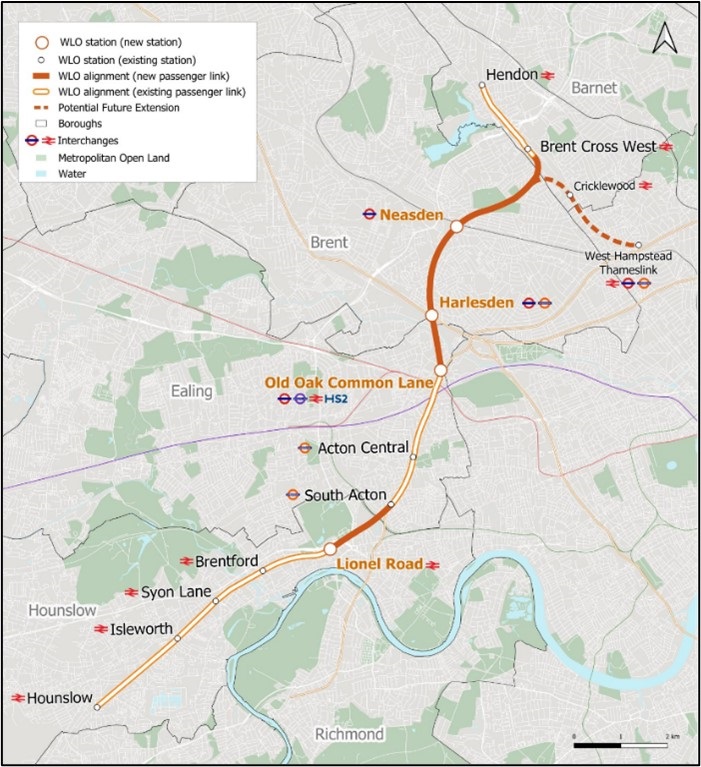
A branch to West Hampstead Thameslink station, through Cricklewood, was previously presented as part of the WLO proposal in the Mayor’s Transport Strategy and was considered alongside other options as part of our detailed assessment of potential routes. However, for several reasons, we have decided not to take forward this branch as part of the proposed route.
Forecasts show around seven times fewer passengers would use a branch to West Hampstead Thameslink compared to the route to Hendon. It would also make the WLO around £100m more costly to deliver. So, the branch doesn't currently offer enough benefit compared to its cost and complexity.
Customers using Cricklewood station would still benefit from the WLO in the area, with journeys to key destinations along the WLO route via a short walk or Thameslink journey to Brent Cross West station.
A branch to West Hampstead Thameslink station could still be brought forward in the future, for example if there is evidence that more passengers can be expected to use the branch, and if extra funding became available. It is intended to protect the route to keep this option open and the case for inclusion will be kept under review.
Further Information
Learn more about the track and infrastructure upgrades needed to operate the line and about our plans for storing, maintaining and cleaning trains when they are not in service.
Stations
The West London Orbital (WLO) would serve 12 stations, including four new ones.
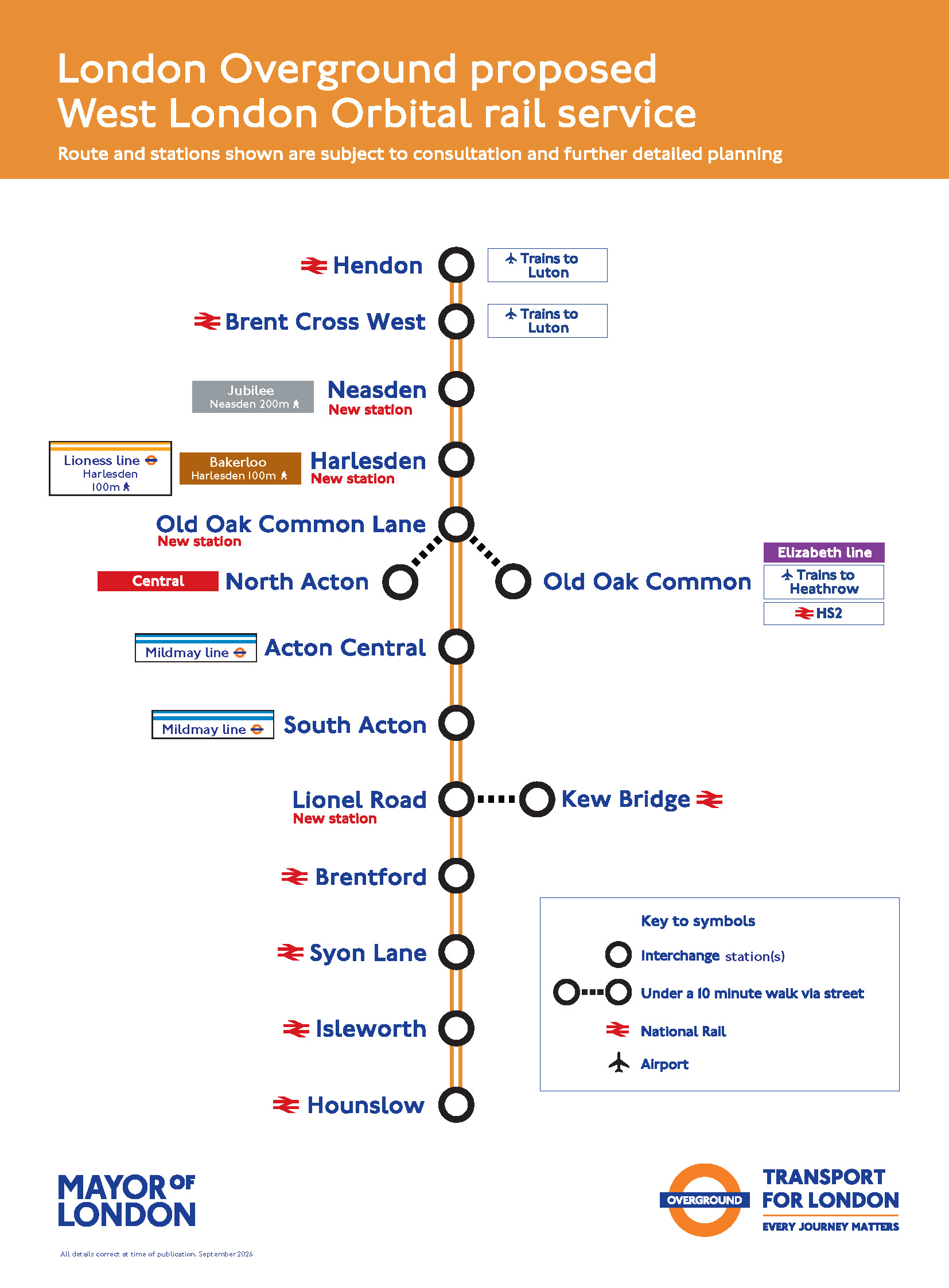
Existing stations
The WLO would serve several existing stations, some of which may need upgrades such as new platforms, step‑free access improvements or changes to station layouts. Changes are proposed for:
- Hendon
- Brent Cross West
- Acton Central
- South Acton
- Brentford
- Isleworth
- Syon Lane
- Hounslow
Learn more about changes to existing stations.
New stations
Four new stations are proposed to fill gaps in the current network and improve connections to key places. These would be:
- Neasden
- Harlesden
- Old Oak Common Lane
- Lionel Road
The stations would offer new links to other rail services and support growth in their surrounding areas.
Learn more about the proposed new stations.
How it may impact you
We believe that the West London Orbital (WLO) would bring significant improvements to the way people travel around and through west London.This includes better interchange with other rail, London Underground and Overground services, reduced journey times and more frequent services. It would also provide accessibility improvements, such as more step free access at stations, more reliable services and would be an alternative to car use. Find out more about the potential benefits of the WLO.
As with any large transport project, there are also some challenges which need to be carefully considered – potentially there are both temporary impacts during construction and permanent impacts once the new WLO services have started.
Find out more about the potential impacts during construction and operation.
Find out more about impacts to level-crossings on the route.
We want to ensure you have the information you need to understand the proposals. On this page, you can find out how to ask questions, attend a drop-in event, and access additional information and supporting materials.
Questions?
You can use our question tool during the consultation period. We will respond to your questions as soon as we can.
You can also contact us by email, via our telephone call back service (020 3054 6037) or in writing (FREEPOST TFL HAVE YOUR SAY)
Drop-in events
We are holding a series of drop-in events where you can learn more about our proposals. Further details including when and where these are taking place can be found here.
More information
We have provided more information to help you respond and a set of Frequently Asked Questions.
Accessible information
We want to make sure everyone can take part in our consultations. To help make it accessible to everyone we have provided our consultation information in the following formats:
 British Sign Language
 Easy Read
 Audio files
Translation
You can also translate the information on this page into another language by using the ‘Select language’ button at the bottom of the page
British Sign Language
To further enhance how we consult with London's deaf community we have provided a British Sign Language (BSL) video of our proposals and survey:
BSL video of our proposals
We are delighted to enable British Sign Language users to contact us using a British Sign Language video interpreter, via the Interpreters Live service, provided by Sign Solutions. Please click the image below to connect now:
Easy Read
Audio files
Tell us your views
You can reply by completing our survey, which should take no more than 10 minutes to complete or if you are short on time, you can submit a quick response.
 |  |
The closing date for comments is 18 November 2026.
Return to the top of the pageNext steps
Thank you for taking the time to review our consultation. Please make sure you have submitted a survey response so that we hear your views on our proposal for the WLO.
When the consultation has closed we will review all the feedback we receive. Your comments will help us:
- Assess the impacts of the proposals
- Shape the next stage of work, including how we design the new stations
We will then publish:
- A consultation report
- Our responses to the issues raised
Everyone who responds to the consultation will receive a copy of this report and it will be published on the consultation website. We aim to publish this report in early 2027.
We are currently at an early stage of developing our designs and determining the full costs and benefits of the scheme. Further work is underway, including developing the design of the stations and other infrastructure, testing the railway timetable, assessing the benefits to passengers and impacts on the road network, and considering the environmental impacts. Your consultation responses will help inform this work as it progresses.
We are also working with the government and local partners to identify the funding that would be needed to deliver the WLO, and progress with this is critical to ensure that construction can begin and services can start operating within the expected timescales.
Subject to making this progress on securing funding, at the end of 2027 we will decide whether to prepare a Transport and Works Act Order application which, if successful, would give us the necessary consents and powers to construct and operate the WLO.
In this case, we would hold another public consultation as part of this next stage of work, where we would set out our final proposals in more detail, including the impacts associated with construction and operation of the WLO.
Subject to securing the necessary consents and powers, and a sustainable funding package, construction could begin in the early 2030s and the new WLO service could start operating by 2035.
Return to the top of the pageAsk us a question
If you have any questions about the scheme, you can ask us here and we will get back to you.
Please note that any questions you ask may be visible to others and will be subject to moderation. Any personal information will be kept confidential but your user name will be displayed. Further details on moderation are available here and privacy here.